Organic Compounds Containing Halogens — DPP 2

20 NEET questions from Organic Compounds Containing Halogens, with answers and explanations. Attempt it as a timed test to get scoring, accuracy breakdown and mistake tracking.

Attempt this test free 20 questions · 30 minutes · +80 marks
1
An $\mathrm { S } _ { \mathrm { N } } 2$ reaction at an asymmetric carbon of a compound always gives
  1. A An enantiomer of the substrate
  2. B A product with opposite optical rotation
  3. C A mixture of diastereomers
  4. D A product with $100 \%$ inversion
Show answer & explanation

Correct answer: D

S$_{N}$2 reaction involves $100 \%$ inversion.
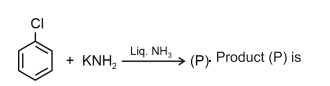
2
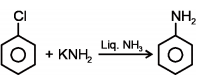
Organic Compounds Containing Halogens – NEET-15254
  1. A
  2. B
  3. C
  4. D
Show answer & explanation

Correct answer: D

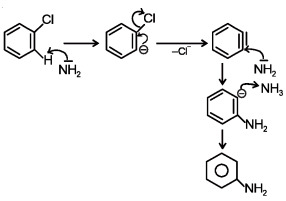
Organic Compounds Containing Halogens – NEET-15254 The reaction occurs via benzyne mechanism.
Organic Compounds Containing Halogens – NEET-15254

3
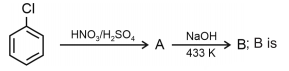
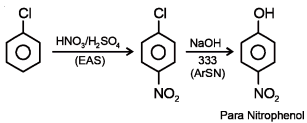
Organic Compounds Containing Halogens – NEET-15247
  1. A
  2. B
  3. C
  4. D
Show answer & explanation

Correct answer: D

Organic Compounds Containing Halogens – NEET-15247
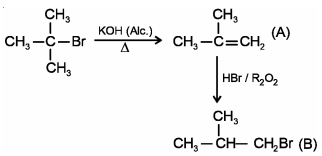
4
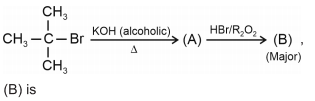
Organic Compounds Containing Halogens – NEET-15212
  1. A
  2. B
  3. C
  4. D
Show answer & explanation

Correct answer: A

Organic Compounds Containing Halogens – NEET-15212 The reaction sequence is basically an elimination reaction followed by Anti-markovnikov's addition.
5
The compound which will undergo $\mathrm { S } _ { \mathrm { N } } 1$ reaction most readily is
  1. A
  2. B
  3. C
  4. D
Show answer & explanation

Correct answer: D

Tertiary carbonium ion is formed most easily in option (4)
6
Which of the following is used as fire extinguisher under the name pyrene?
  1. A $\mathrm { CO } _ { 2 }$
  2. B $\mathrm { CCl } _ { 4 }$
  3. C $\mathrm { CH } _ { 2 } = \mathrm { CH } - \mathrm { Cl }$
  4. D $\mathrm { Cl } - \mathrm { CH } = \mathrm { CH } - \mathrm { Cl }$
Show answer & explanation

Correct answer: B

$\mathrm{CCl}_{4}$ is sold under the name of pyrene.
7
Which of the following acts as a poisonous gas?
  1. A $\mathrm { COCl } _ { 2 }$
  2. B $\mathrm { CCl } _ { 2 } \mathrm {F} _ { 2 }$
  3. C Benzene
  4. D $\mathrm { CH } _ { 3 } \mathrm { Cl }$
Show answer & explanation

Correct answer: A

Among the following $\mathrm{COCl}_{2}$ called (Phosgene) is a poisonous gas.
8
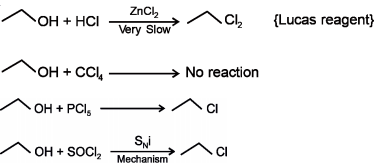
Which one of the following reagents will not convert ethyl alcohol into ethyl chloride?
  1. A $\mathrm { HCl } - \mathrm { ZnCl } _ { 2 }$
  2. B $\mathrm { CCl } _ { 4 }$
  3. C $\mathrm { PCl } _ { 5 }$
  4. D $\mathrm { SOCl } _ { 2 }$
Show answer & explanation

Correct answer: B

Organic Compounds Containing Halogens – NEET-14979
9
Which of the following belongs to the class of vinyl halides?
  1. A $\mathrm { CH } _ { 2 } = \mathrm { CH } - \mathrm { CHBr } - \mathrm { CH } _ { 3 }$
  2. B
  3. C $\mathrm { HC } \equiv \mathrm { C } - \mathrm { Br }$
  4. D $\mathrm { CH } _ { 3 } - \mathrm { CH } = \mathrm { CH } - \mathrm { CH } _ { 2 } - \mathrm { Br }$
Show answer & explanation

Correct answer: B

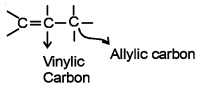
Organic Compounds Containing Halogens – NEET-14969 This is vinyl Halide
Organic Compounds Containing Halogens – NEET-14969Double bonded 'C' atoms are vinylic carbon.
10
$\mathrm { CH } _ { 3 } - \mathrm { CH } = \mathrm { CH } _ { 2 } + \mathrm { HOBr } \longrightarrow$ P; The major product ' P ' is
  1. A
  2. B
  3. C
  4. D
Show answer & explanation

Correct answer: B

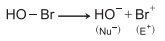
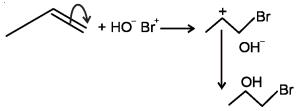
Organic Compounds Containing Halogens – NEET-15016HOBr dissociates as
Organic Compounds Containing Halogens – NEET-15016 And alkene follows electrolphylic addition reaction. So, $\mathrm{Br}^{+}$attack at first and then $\mathrm{OH}^{-}$attack.
11
Which of the following is known as freon $12 ?$
  1. A $\mathrm { CHCl } _ { 3 }$
  2. B $\mathrm { CCl } _ { 2 } \mathrm {F} _ { 2 }$
  3. C $\mathrm { Ph } - \mathrm { COCH } _ { 2 } \mathrm { Cl }$
  4. D $\mathrm { Ph } - \mathrm { Cl }$
Show answer & explanation

Correct answer: B

Freon 12 is $\mathrm{CF}_{2} \mathrm{Cl}_{2}$.
12
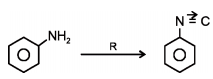
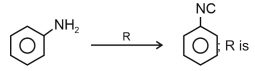
Organic Compounds Containing Halogens – NEET-15263
  1. A $\mathrm { N } _ { 2 }$
  2. B $\mathrm { CHCl } _ { 3 } / \mathrm { KOH }$ (alcoholic)
  3. C $\mathrm { NH } _ { 3 }$
  4. D
Show answer & explanation

Correct answer: B

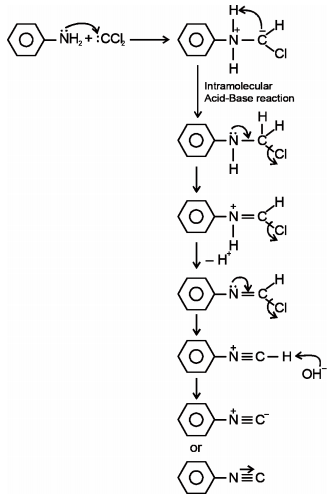
Organic Compounds Containing Halogens – NEET-15263 R must be $\mathrm{CHCl}_{3}, \mathrm{OH}^{-}$
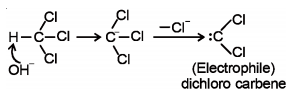
Mechanism -
Step Ist:
Organic Compounds Containing Halogens – NEET-15263 Step IInd:
Organic Compounds Containing Halogens – NEET-15263
13
Organic Compounds Containing Halogens – NEET-15119
  1. A
  2. B
  3. C
  4. D
Show answer & explanation

Correct answer: B

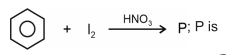
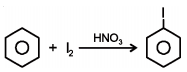
Organic Compounds Containing Halogens – NEET-15119 $\mathrm{HNO}_{3}$ oxidises $\mathbf{I}_{2}$ to $\mathbf{I}^{+}$, so that electrophilic generation becomes easier and hence the electrophilic aromatic substitution reaction.
This reaction is an example of electrophilic Aromatic substitution.
14
Which of the following is used as a refrigerant?
  1. A $\mathrm { COCl } _ { 2 }$
  2. B $\mathrm { CCl } _ { 4 }$
  3. C $\mathrm { CF } _ { 4 }$
  4. D $\mathrm { CF } _ { 2 } \mathrm { Cl } _ { 2 }$
Show answer & explanation

Correct answer: D

Dichloro difluoro carbon is used as a refrigerant.
15
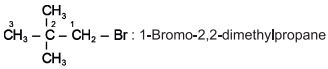
IUPAC name of neopentyl bromide is
  1. A 1-Bromo-4, 4-dimethylpentane
  2. B 1-Bromo-3-methylbutane
  3. C 1-Bromo-2, 2-dimethylpropane
  4. D 2-Bromo-2-methylbutane
Show answer & explanation

Correct answer: C

Organic Compounds Containing Halogens – NEET-15303
16
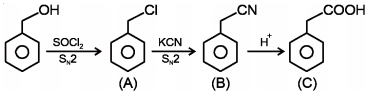
the compound $( \mathrm { C } )$ is
  1. A
  2. B
  3. C
  4. D
Show answer & explanation

Correct answer: C

Organic Compounds Containing Halogens – NEET-15238Hence, the product (C) is an acid shown.
17
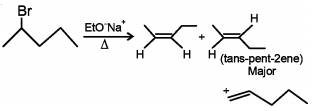
2-Bromopentane is heated with $\mathrm { EtO } ^ { - } \mathrm { Na } ^ { + }$in ethanol. The major product obtained is
  1. A 2-Ethoxypentane
  2. B Pent-1-ene
  3. C Isobutane
  4. D Pent-2-ene
Show answer & explanation

Correct answer: D

Organic Compounds Containing Halogens – NEET-15219
18
Which among the given compounds has highest dipole moment?
  1. A $\mathrm { CH } _ { 3 } \mathrm {~F}$
  2. B $\mathrm { CH } _ { 3 } \mathrm { Br }$
  3. C $\mathrm { CH } _ { 3 } \mathrm { I }$
  4. D $\mathrm { CH } _ { 3 } \mathrm { Cl }$
Show answer & explanation

Correct answer: D

Dipole moment order is
$\mathrm{CH}_{3} \mathrm{Cl}>\mathrm{CH}_{3} \mathrm{~F}>\mathrm{CH}_{3} \mathrm{Br}>\mathrm{CH}_{3} \mathrm{I}$
19
Which of the following solvent is suitable for $\mathrm { S } _ { \mathrm { N } } 1$ reaction?
  1. A Non-polar
  2. B Polar protic
  3. C Polar aprotic
  4. D All of these
Show answer & explanation

Correct answer: B

$\mathrm{S}_{\mathrm{N}} 1$ reaction demands polar protic solvents in order to stabilize the intermediate carbocation.
20
Which among the following is an ambidented nucleophile?
  1. A $\mathrm { NO } _ { 2 } ^ { - }$
  2. B $\mathrm { NH } _ { 3 }$
  3. C $\mathrm { RCOO } ^ { \ominus }$
  4. D $\mathrm { CH } _ { 3 } \mathrm { NH } _ { 2 }$
Show answer & explanation

Correct answer: A

$\mathrm{NO}_{2}^{-}$can donate electron through by N and O .

Attempt this as a timed test

Reading answers is not the same as sitting the paper. Attempt it timed and you get your score, per-question timing, and the mistakes tracked for revision.

Start free

More Organic Compounds Containing Halogens tests

All Organic Compounds Containing Halogens tests →