Alternating Current — DPP 1

20 NEET questions from Alternating Current, with answers and explanations. Attempt it as a timed test to get scoring, accuracy breakdown and mistake tracking.

Attempt this test free 20 questions · 30 minutes · +80 marks
1
What is the r.m.s. value of an alternating current which when passed through a resistor produces heat which is thrice of that produced by a direct current of 2 amperes in the same resistor :-
  1. A 6 amp
  2. B 2 amp
  3. C 3.46 amp
  4. D 0.66 amp
Show answer & explanation

Correct answer: C

Given that,
$\begin{array}{l}\mathrm{H}_{\mathrm{AC}}=3 \mathrm{H}_{\mathrm{DC}} \\ \mathrm{I}_{\mathrm{rms}}^{2} \mathrm{Rt}=3\left(\mathrm{I}^{2} \mathrm{Rt}\right) \\ \mathrm{I}_{\mathrm{rms}}^{2}=3 \mathrm{I}^{2} \\ \mathrm{I}_{\mathrm{rms}}=\sqrt{3} \mathrm{I}=\sqrt{3} 2 \\ \mathrm{I}_{\mathrm{rms}}=3.46 \mathrm{~A}\end{array}$
2
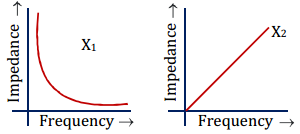
The graphs given below depict the dependence of two reactive impedances $\mathrm { X } _ { 1 }$ and $X _ { 2 }$ on the frequency of the alternating e.m.f. applied individually to them. We can then say that :
Alternating Current – NEET-5190
  1. A $X _ { 1 }$ is an inductor and $X _ { 2 }$ is a capacitor
  2. B $X _ { 1 }$ is a resistor and $X _ { 2 }$ is a capacitor
  3. C $X _ { 1 }$ is a capacitor and $X _ { 2 }$ is an inductor
  4. D $X _ { 1 }$ is an inductor and $X _ { 2 }$ is a resistor
Show answer & explanation

Correct answer: C

$\begin{array}{l}\mathrm{X}_{\mathrm{L}}=2 \pi \mathrm{fL} \\ \mathrm{X}_{\mathrm{L}} \propto \mathrm{f}(\text { graph straight line }) \\ \mathrm{X}_{\mathrm{C}}=\frac{1}{2 \pi \mathrm{fC}} ; \quad \mathrm{X}_{\mathrm{C}} \propto \frac{1}{\mathrm{C}}\end{array}$
(graph rectangular hyperbola)
3
A capacitor of capacity C is connected in A.C. circuit. The applied emf is $V = V _ { 0 } \sin \omega t$, then the current is :
  1. A $I = \frac { V _ { 0 } } { \omega L } \sin \omega t$
  2. B $\mathrm { I } = \frac { \mathrm { V } _ { 0 } } { \omega \mathrm {~L} } \sin ( \omega \mathrm { t } + \pi / 2 )$
  3. C $I = V _ { 0 } \omega C \sin \omega t$
  4. D $I = V _ { 0 } \omega C \sin ( \omega t + \pi / 2 )$
Show answer

Correct answer: D

4
Incorrect statement are :
(a) A.C. meters can measure D.C also
(b) If A.C. meter measures D.C. there scale must be linear and uniform
(c) A.C. and D.C. meters are based on heating effect of current
(d) A.C. meter reads rms value of current
  1. A a , b
  2. B b, c
  3. C c, d
  4. D d, a
Show answer

Correct answer: B

5
An a.c. source of voltage V and of frequency 50 Hz is connected to an inductor of 2 H and negligible resistance. A current of r.m.s value I flows in the coil. When the frequency of the voltage is changed to 400 Hz keeping the magnitude of V the same, the current is now :-
  1. A 8 I in phase with V
  2. B 4 I and leading by $90 ^ { \circ }$ from V
  3. C $\frac { \mathrm { I } } { 4 }$ and lagging by $90 ^ { \circ }$ from V
  4. D $\frac { \mathrm { I } } { 8 }$ and lagging by $90 ^ { \circ }$ from V
Show answer & explanation

Correct answer: D

$I=\frac{V}{Z}$
Z = ωL = 2π × 50 × 2 = 200π
$I_{1}=\frac{V}{200 \pi}$
on frequency 400 Hz
Z = ωL = 2π × 400 × 2
$I_{2}=\frac{V}{1600 \pi} ; \frac{I_{1}}{I_{2}}=\frac{V}{200 \pi} \times \frac{1600 \pi}{V}=8$
$I_{2}=\frac{I_{1}}{8}$
(lagging by 90° from V due to purely inductive circuit)
OR
XL ∝ f, f becomes 8 times, so X$_{L}$ also becomes 8 times, so current becomes 1/8 times and lagging by 90° from V (pure inductive circuit)
6
The resistance that must be connected in series with inductance of 0.2 H in order that the phase difference between current and e.m.f. may be $45 ^ { \circ }$ when the frequency is 50 Hz , is:-
  1. A 6.28 ohm
  2. B 62.8 ohm
  3. C 628 ohm
  4. D 31.4 ohm
Show answer

Correct answer: B

7
A student connects a long air cored - coil of manganin wire to a 100 V D.C. supply and records a current of 25 amp . When the same coil is connected across 100 V .50 Hz a.c. the current reduces to 20 A , the reactance of the coil is :-
  1. A $4 \Omega$
  2. B $3 \Omega$
  3. C $5 \Omega$
  4. D None
Show answer & explanation

Correct answer: B

For DC. V = IR
$\mathrm{R}=\frac{\mathrm{V}}{\mathrm{I}}=\frac{100}{25}$
R = 4Ω (Resistance of coil)
For AC, V = IZ
$\mathrm{Z}=\frac{\mathrm{V}}{\mathrm{I}}=\frac{100}{20}$
Z = 5Ω
Z$^{2}$ = R$^{2}$ + X$^{2}$
X$^{2}$ = Z$^{2}$ – R$^{2}$ = 5$^{2}$ – 4$^{2}$
Reactance of coil X = 3Ω
8
Alternating current is flowing in inductance L and resistance R . The frequency of source is $\omega / 2 \pi$. Which of the following statement is correct :
  1. A For low frequency the limiting value of impedance is L .
  2. B For high frequency the limiting value of impedance is $\omega \mathrm { L }$.
  3. C For high frequency the limiting value of impedance is R .
  4. D For low frequency the limiting value of impedance is $\omega \mathrm { L }$.
Show answer

Correct answer: B

9
The relation between an A.C. voltage source and time in SI units is : $\mathrm { V } = 120 \sin ( 100 \pi \mathrm { t } ) \cos ( 100 \pi \mathrm { t } )$ volt value of peak voltage and frequency will be respectively :-
  1. A 120 volt and 100 Hz
  2. B $\frac { 120 } { \sqrt { 2 } }$ volt and 100 Hz
  3. C 60 volt and 200 Hz
  4. D 60 volt and 100 Hz
Show answer & explanation

Correct answer: D

$\begin{array}{l}V=120 \sin (100 \pi t) \cos (100 \pi t) \\ \because 2 \sin \theta \cos \theta=\sin 2 \theta \\ \therefore \sin (100 \pi t) \cos (100 \pi t)=\frac{\sin (2 \times 100 \pi t)}{2} \\ V=60 \sin (200 \pi t) \\ \operatorname{compare~from} \\ V=V_{0} \sin \omega t \\ V_{0}=60 \text { volt, } \\ \omega=200 \pi \\ 2 \pi f=200 \pi \\ f=100 \mathrm{~Hz}\end{array}$
10
A 12 ohm resistor and a 0.21 henry inductor are connected in series to an AC source operating at 20 volts, 50 cycle/second. The phase angle between the current and the source voltage is:
  1. A $30 ^ { \circ }$
  2. B $40 ^ { \circ }$
  3. C $80 ^ { \circ }$
  4. D $90 ^ { \circ }$
Show answer & explanation

Correct answer: C

$\begin{array}{l}\tan \phi=\frac{\mathrm{X}_{\mathrm{L}}}{\mathrm{R}} \\ \tan \phi=\frac{2 \pi \times 50 \times 0.21}{12} \\ \tan \phi \approx 5.5 \\ \text { Now } \tan 60^{\circ}=\sqrt{3} \text { and } 5.5>\sqrt{3}\end{array}$
So, angle will be greater 60°.
11
If an A.C. main supply is given to be 220 V . What would be the average e.m.f. during a positive half cycle :-
  1. A 198 V
  2. B 386 V
  3. C 256 V
  4. D None of these
Show answer & explanation

Correct answer: A

$\mathrm{V}_{\mathrm{avg}}=\frac{2 \mathrm{~V}_{0}}{\pi}=\frac{2 \sqrt{2} \mathrm{~V}_{\mathrm{rms}}}{\pi}=\frac{2 \sqrt{2} \times 220}{3.14}=198$ Volt
12
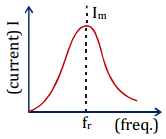
The graph shows variation of I with f for a series R-L-C network. Keeping L and C constant, if R decreases :
Alternating Current – NEET-5195
(a) Maximum current (I$_{m}$) increases
(b) Sharpness of the graph increases
(c) Quality factor increases
(d) Band width increases
  1. A a, b, c
  2. B b, c, d
  3. C c, d, a
  4. D All
Show answer

Correct answer: A

13
In an A.C. circuit resistance and inductance are connected in series. The potential and current in inductance is:
  1. A $\mathrm { V } _ { 0 } \sin \omega \mathrm { t } , \frac { \mathrm { V } _ { 0 } } { \omega \mathrm {~L} } \sin \omega \mathrm { t }$
  2. B $\mathrm { V } _ { 0 } \sin \omega \mathrm { t } , \frac { \mathrm { V } _ { 0 } } { \omega \mathrm {~L} } \sin ( \omega \mathrm { t } + \pi / 2 )$
  3. C $\mathrm { V } _ { 0 } \sin ( \omega \mathrm { t } + \pi / 2 ) , \frac { \mathrm { V } _ { 0 } } { \omega \mathrm {~L} } \sin \omega \mathrm { t }$
  4. D $\mathrm { V } _ { 0 } \sin ( \omega \mathrm { t } + \pi / 2 ) , \frac { \mathrm { V } _ { 0 } } { \omega \mathrm {~L} } \sin ( \omega \mathrm { t } - \pi / 2 )$
Show answer

Correct answer: C

14
The peak value of an alternating e.m.f. which is given by E = E$_{0}$ cosωt is 10 volts and its frequency is 50 Hz. At time $\mathrm { t } = \frac { 1 } { 600 } \mathrm {~s}$, the instantaneous e.m.f. is
  1. A 10 V
  2. B 5√3 V
  3. C 5 V
  4. D 1 V
Show answer & explanation

Correct answer: B

$\begin{array}{l}\mathrm{E}=\mathrm{E}_{0} \cos \omega \mathrm{t} \\ \text { Given, } \mathrm{E}_{0}=10 \mathrm{~V}, \mathrm{t}=\frac{1}{600} \text { sec., } \mathrm{f}=50 \mathrm{~Hz} \\ \mathrm{E}=10 \cos \left(2 \pi \times 50 \times \frac{1}{600}\right) \\ \mathrm{E}=10 \cos \frac{\pi}{6} \rightarrow \mathrm{E}=5 \sqrt{3} \mathrm{~V}\end{array}$
15
The phase difference between current and voltage in an AC circuit is $\frac { \pi } { 4 }$ radian. If the frequency of AC is 50 Hz , then the phase difference is equivalent to the time difference:-
  1. A 0.78 s
  2. B 15.7 ms
  3. C 2.5 s
  4. D 2.5 ms
Show answer & explanation

Correct answer: D

∵2π(phase difference) ≡ T(Time difference)
1 rad (PD) $\frac{\mathrm{T}}{2 \pi}$ (Time difference)
So, $\frac{\pi}{4}(\mathrm{PD}) \equiv \frac{\mathrm{T}}{2 \pi} \times \frac{\pi}{4}$ (Time difference) $=\frac{\mathrm{T}}{8} \Rightarrow$ time difference $=\frac{1}{50 \times 8} \mathrm{~s}$
or time difference = 2.5 ms.
16
If a step-up transformer have turn ratio 5 , frequency 50 Hz root mean square value of potential difference on primary 100 volts and the resistance of the secondary winding is $500 \Omega$ then the peak value of voltage in secondary winding will be (the efficiency of the transformer is hundred percent)
  1. A $500 \sqrt { 2 }$
  2. B $10 \sqrt { 2 }$
  3. C $50 \sqrt { 2 }$
  4. D $20 \sqrt { 2 }$
Show answer & explanation

Correct answer: A

Peak voltage in primary $\mathrm{V}_{0}=\sqrt{2} \mathrm{~V}_{\mathrm{rms}}=100 \sqrt{2}$
$\begin{array}{l}\frac{V_{s}}{V_{p}}=\frac{N_{2}}{N_{1}} \Rightarrow V_{s}=\frac{N_{s}}{N_{p}} \times V_{p} \\ V_{s}=5 \times 100 \sqrt{2}=500 \sqrt{2} \mathrm{Volt}\end{array}$
17
A resistance of $300 \Omega$ and an inductance of $\frac { 1 } { \pi }$ henry are connected in series to a A.C. voltage of 20 volts and 200 Hz frequency. The phase angle between the voltage and current is :-
  1. A $\tan ^ { - 1 } \left( \frac { 4 } { 3 } \right)$
  2. B $\tan ^ { - 1 } \left( \frac { 3 } { 4 } \right)$
  3. C $\tan ^ { - 1 } \left( \frac { 3 } { 2 } \right)$
  4. D $\tan ^ { - 1 } \left( \frac { 2 } { 3 } \right)$
Show answer

Correct answer: A

18
A resonant A.C. circuit contains a capacitor of capacitance $10 ^ { - 6 } \mathrm {~F}$ and an inductor of $10 ^ { - 4 } \mathrm { H }$. The frequency of electrical oscillations will be :-
  1. A $10 ^ { 5 } \mathrm {~Hz}$
  2. B 10 Hz
  3. C $\frac { 10 ^ { 5 } } { 2 \pi } \mathrm {~Hz}$
  4. D $\frac { 10 } { 2 \pi } \mathrm {~Hz}$
Show answer

Correct answer: C

19
For an alternating current $\mathrm { I } = \mathrm { I } _ { 0 } \cos \omega \mathrm { t }$, the rms value and peak value of current is:-
  1. A $\mathrm { I } _ { 0 } , \frac { \mathrm { I } _ { 0 } } { \sqrt { 2 } }$
  2. B $\frac { \mathrm { I } _ { 0 } } { \sqrt { 2 } } , \mathrm { I } _ { 0 }$
  3. C $\mathrm { I } _ { 0 } , \frac { \mathrm { I } _ { 0 } } { 2 }$
  4. D $2 \mathrm { I } _ { 0 } , \frac { \mathrm { I } _ { 0 } } { \sqrt { 2 } }$
Show answer

Correct answer: B

20
A bulb and a capacitor are connected in series to a source of alternating current. If its frequency is increased, while keeping the voltage of the source constant, then
  1. A Bulb will give more intense light.
  2. B Bulb will give less intense light.
  3. C Bulb will give light of same intensity as before
  4. D Bulb will stop radiating light.
Show answer

Correct answer: A

Attempt this as a timed test

Reading answers is not the same as sitting the paper. Attempt it timed and you get your score, per-question timing, and the mistakes tracked for revision.

Start free

More Alternating Current tests

All Alternating Current tests →