Alternating Current — DPP 3

20 NEET questions from Alternating Current, with answers and explanations. Attempt it as a timed test to get scoring, accuracy breakdown and mistake tracking.

Attempt this test free 20 questions · 30 minutes · +80 marks
1
In an A.C. circuit inductance, capacitance and resistance are connected. If the effective voltage across inductance is V$_{L}$, across capacitance is V$_{c}$ and across resistance is V$_{R}$, then the total effective value of voltage is :
  1. A $\mathrm { V } _ { \mathrm { R } } + \mathrm { V } _ { \mathrm { L } } + \mathrm { V } _ { \mathrm { c } }$
  2. B $\mathrm { V } _ { \mathrm { R } } + \mathrm { V } _ { \mathrm { L } } - \mathrm { V } _ { \mathrm { c } }$
  3. C $\sqrt { \mathrm { V } _ { \mathrm { R } } ^ { 2 } + \left( \mathrm { V } _ { \mathrm { L } } - \mathrm { V } _ { \mathrm { C } } \right) ^ { 2 } }$
  4. D $\sqrt { \mathrm { V } _ { \mathrm { R } } ^ { 2 } - \left( \mathrm { V } _ { \mathrm { L } } - \mathrm { V } _ { \mathrm { C } } \right) ^ { 2 } }$
Show answer

Correct answer: C
2
Which is not correct for average power P at resonance :
  1. A $P = I _ { \text {rms } } V _ { \text {rms } }$
  2. B $\mathrm { P } = \frac { \mathrm { V } } { \sqrt { 2 } } \frac { \mathrm { I } } { \sqrt { 2 } }$
  3. C $\mathrm { P } = \mathrm { VI }$
  4. D $P = I ^ { 2 } { } _ { r \mathrm {~ms} } R$
Show answer

Correct answer: C

3
Energy loss in pure capacitance in A.C. circuit is
  1. A $\frac { 1 } { 2 } \mathrm { CV } ^ { 2 }$
  2. B CV
  3. C $\frac { 1 } { 4 } \mathrm { CV } ^ { 2 }$
  4. D Zero
Show answer

Correct answer: D

4
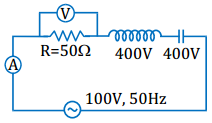
In given LCR circuit, the voltage across the terminals of a resistance & current will be-
Alternating Current – NEET-5376
  1. A 400V, 2A
  2. B 800V, 2A
  3. C 100V, 2A
  4. D 100V, 4A
Show answer & explanation

Correct answer: C

V$_{L}$ = V$_{C}$
∴ X$_{L}$ = X$_{C}$ (Resonance condition)
$i=\frac{V}{R}=\frac{100}{50}=2 \mathrm{~A}$
V$_{R}$ = iR = 2 × 50 = 100 V
5
An inductor of inductance L and resistor of resistance R are joined in series and connected by a source of frequency Ω. Power dissipated in the circuit is :-
  1. A $\frac { \left( \mathrm { R } ^ { 2 } + \omega ^ { 2 } \mathrm {~L} ^ { 2 } \right) } { \mathrm { V } }$
  2. B $\frac { \mathrm { V } ^ { 2 } \mathrm { R } } { \left( \mathrm { R } ^ { 2 } + \omega ^ { 2 } \mathrm {~L} ^ { 2 } \right) }$
  3. C $\frac { V } { \left( R ^ { 2 } + \omega ^ { 2 } L ^ { 2 } \right) }$
  4. D $\frac { \sqrt { R ^ { 2 } + \omega ^ { 2 } L ^ { 2 } } } { V ^ { 2 } }$
Show answer

Correct answer: B

6
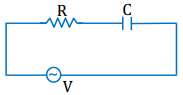
A 50 Hz a.c. source of 20 V is connected across R and C as shown in figure below.
Alternating Current – NEET-5218 The voltage across R is 12 V. The voltage across C is
  1. A 8 V
  2. B 16 V
  3. C 10 V
  4. D Not possible to determine unless values of R and C are given
Show answer & explanation

Correct answer: B

Use $V^{2}=V_{R}^{2}+V_{C}^{2}$
7
In an alternating circuit applied voltage and current are $\mathrm { E } = \mathrm { E } _ { 0 } \sin \omega \mathrm { t }$ and $\mathrm { I } = \mathrm { I } _ { 0 } \sin ( \omega \mathrm { t } + \pi / 2 )$ respectively. Then the power consumed in the circuit will be :
  1. A Zero
  2. B $\mathrm { E } _ { 0 } \mathrm { I } _ { 0 } / 2$
  3. C $\mathrm { E } _ { 0 } \mathrm { I } _ { 0 } / \sqrt { 2 }$
  4. D $\mathrm { E } _ { 0 } \mathrm { I } _ { 0 } / 4$
Show answer & explanation

Correct answer: A

E = E$_{0}$ sin ωt
$\mathrm{I}=\mathrm{I}_{0} \sin \left(\omega \mathrm{t}+\frac{\pi}{2}\right) \Rightarrow \phi=\frac{\pi}{2}$
cos Φ = 0 so P = 0
8
In a purely capacitive circuit average power dissipated in the circuit is -
  1. A $\mathrm { V } _ { \text {rms } } \mathrm { I } _ { \text {rms } }$
  2. B Depends on capacitance
  3. C Infinite
  4. D Zero
Show answer

Correct answer: D

9
In an AC Circuit decrease in impedance with increase in frequency indicates that circuit has/have :-
  1. A Only resistance
  2. B Resistance & inductance
  3. C Resistance & capacitance
  4. D Resistance, capacitance & inductance
Show answer & explanation

Correct answer: C

Z = $\sqrt{R^{2}+X^{2}}$ [X = reactance]
if ω ↑ than X$_{C}$ ↓, Z ↓
So circuit contain resistance and capacitance
10
If $V = 100 \sin 100 t$ volt, and $I = 100 \sin \left( 100 t + \frac { \pi } { 6 } \right)$ A. then find the watt less power in watt :-
  1. A $10 ^ { 4 }$
  2. B $10 ^ { 3 }$
  3. C $10 ^ { 2 }$
  4. D $2.5 \times 10 ^ { 3 }$
Show answer & explanation

Correct answer: D

Wattless power = V I sin Φ,
Wattless power
$\begin{array}{l}=\frac{100}{\sqrt{2}} \times \frac{100}{\sqrt{2}} \times \sin \frac{\pi}{6}\left\{\begin{array}{l}V=\frac{100}{\sqrt{2}} V \\ I=\frac{100}{\sqrt{2}} A \\ \phi=\frac{\pi}{6}\end{array}\right. \\ =2.5 \times 10^{3} \text { Watt }\end{array}$
11
A capacitor of capacitance 100μF & a resistance of 100Ω is connected in series with AC supply of 220V, 50Hz. The current leads the voltage by
  1. A $\tan ^ { - 1 } \left( \frac { 1 } { 2 \pi } \right)$
  2. B $\tan ^ { - 1 } \left( \frac { 1 } { \pi } \right)$
  3. C $\tan ^ { - 1 } \left( \frac { 2 } { \pi } \right)$
  4. D $\tan ^ { - 1 } \left( \frac { 4 } { \pi } \right)$
Show answer & explanation

Correct answer: B

$\begin{aligned} \tan \phi & =\frac{X_{C}}{R}=\frac{1}{\omega R C} \\ & =\frac{1}{2 \pi \times 50 \times 100 \times 100 \times 10^{-6}}=\frac{1}{\pi} \\ \rightarrow \phi= & \tan ^{-1}\left(\frac{1}{\pi}\right)\end{aligned}$
12
In LCR circuit, the voltage across the terminals of a resistance, inductance & capacitance are 40V, 30V & 60V, then the voltage across the main source will be -
  1. A 130 volt
  2. B 100 volt
  3. C 70 volt
  4. D 50 volt
Show answer & explanation

Correct answer: D

$V^{2}=V_{R}^{2}+\left(V_{L}-V_{C}\right)^{2}$
13
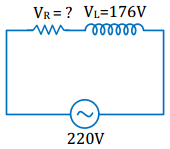
In the figure shown, find V$_{R}$:
Alternating Current – NEET-5246
  1. A 132 V
  2. B 396 V
  3. C 185 V
  4. D $\sqrt { 220 \times 176 } \mathrm {~V}$
Show answer

Correct answer: A

14
A sinusoidal A.C. current flows through a resistor of resistance R . If the peak current is I$_{P}$, then the power dissipated is :-
  1. A $\mathrm { I } _ { \mathrm { p } } ^ { 2 } \mathrm { R } \cos \theta$
  2. B $\frac { 1 } { 2 } \mathrm { I } _ { \mathrm { p } } ^ { 2 } \mathrm { R }$
  3. C $\frac { 4 } { \pi } \mathrm { I } _ { \mathrm { p } } ^ { 2 } \mathrm { R }$
  4. D $\frac { 1 } { \pi ^ { 2 } } \mathrm { I } _ { \mathrm { p } } ^ { 2 } \mathrm { R }$
Show answer

Correct answer: B

15
For an alternating current of frequency $\frac { 500 } { \pi } \mathrm {~Hz}$ in L-C-R series circuit with L = 1H, C = 1 μF, R = 100Ω, impedance is :-
  1. A 100 Ω
  2. B $100 \sqrt { \pi } \Omega$
  3. C $100 \sqrt { 2 \pi } \Omega$
  4. D $100 \pi \Omega$
Show answer

Correct answer: A

16
For a series R-L-C circuit :-
(a) Voltage across L and C are differ by $\pi$
(b) Current through L and R are in same phase
(c) Voltage across R and L differ by $\pi / 2$
(d) Voltage across L and current through C are differ by $\pi / 2$
  1. A a, b, c
  2. B b, c, d
  3. C c, d, a
  4. D All
Show answer

Correct answer: D

17
If alternating current of rms value 'a' flows through resistance R then power loss in resistance is :
  1. A Zero
  2. B a$^{2}$R
  3. C $\frac { a ^ { 2 } R } { 2 }$
  4. D 2a$^{2}$R
Show answer

Correct answer: B

18
The hot wire ammeter measures :-
  1. A D.C. current
  2. B A.C. current
  3. C None of above
  4. D Both (A) & (B)
Show answer

Correct answer: D

19
The power factor of L-R circuit is :
  1. A $\frac { \omega \mathrm { L } } { \mathrm { R } }$
  2. B $\frac { \mathrm { R } } { \sqrt { ( \omega \mathrm { L } ) ^ { 2 } + \mathrm { R } ^ { 2 } } }$
  3. C ωLR
  4. D $\sqrt { \omega \mathrm { LR } }$
Show answer

Correct answer: B

20
In a series LCR circuit voltage across resistor, inductor and capacitor are 1V, 3V and 2V respectively. At the instant t when the source voltage is given by : $\mathrm { V } = \mathrm { V } _ { 0 } \cos \omega \mathrm { t }$, the current in the circuit will be :
  1. A $I = I _ { 0 } \cos \left( \omega t + \frac { \pi } { 4 } \right)$
  2. B $\mathrm { I } = \mathrm { I } _ { 0 } \cos \left( \omega \mathrm { t } - \frac { \pi } { 4 } \right)$
  3. C $\mathrm { I } = \mathrm { I } _ { 0 } \cos \left( \omega \mathrm { t } + \frac { \pi } { 3 } \right)$
  4. D $\mathrm { I } = \mathrm { I } _ { 0 } \cos \left( \omega \mathrm { t } - \frac { \pi } { 3 } \right)$
Show answer & explanation

Correct answer: B

$\tan \phi=\frac{\mathrm{V}_{\mathrm{L}}-\mathrm{V}_{\mathrm{C}}}{\mathrm{V}_{\mathrm{R}}}=\frac{1}{1}=45^{\circ}$
V$_{L}$ > V$_{C}$
So current lags by $\frac{\pi}{4}$
$\therefore \mathrm{I}=\mathrm{I}_{0} \cos \left(\omega \mathrm{t}-\frac{\pi}{4}\right)$

Attempt this as a timed test

Reading answers is not the same as sitting the paper. Attempt it timed and you get your score, per-question timing, and the mistakes tracked for revision.

Start free

More Alternating Current tests

All Alternating Current tests →