Alternating Current — DPP 2

20 NEET questions from Alternating Current, with answers and explanations. Attempt it as a timed test to get scoring, accuracy breakdown and mistake tracking.

Attempt this test free 20 questions · 30 minutes · +80 marks
1
The coil of choke in a circuit :
  1. A increases the current
  2. B controls the current
  3. C has high resistance to d.c. circuit
  4. D does not change the current
Show answer

Correct answer: B
2
When $\mathrm { V } = 100$ sin $\omega t$ is applied across a series (R-L-C) circuit, at resonance the current in resistance ( $\mathrm { R } = 100 \Omega$ ) is $\mathrm { i } = \mathrm { i } _ { 0 } \sin \omega \mathrm { t }$, then power dissipation in circuit is:-
  1. A 50 W
  2. B 100 W
  3. C 25 W
  4. D Can't be calculated
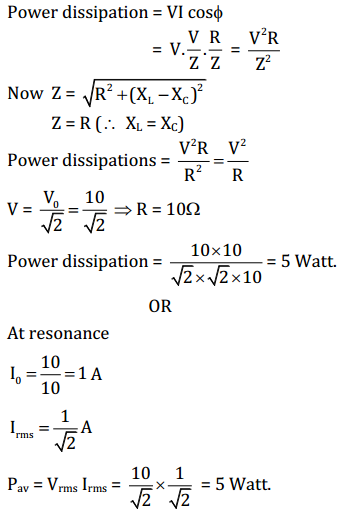
Show answer

Correct answer: A

3
In the L-R circuit R = 10Ω and L = 2H. If 120V, 60Hz alternating voltage is applied then the flowing current in this circuit will be :-
  1. A 0.32 A
  2. B 0.16 A
  3. C 0.48 A
  4. D 0.80 A
Show answer

Correct answer: B

4
The r.m.s. value of current for a variable current $\mathrm{i}=\mathrm{i}_{1} \cos \omega \mathrm{t}+\mathrm{i}_{2} \sin \omega \mathrm{t}$
  1. A $\frac { 1 } { \sqrt { 2 } } \left( \mathrm { i } _ { 1 } + \mathrm { i } _ { 2 } \right)$
  2. B $\frac { 1 } { \sqrt { 2 } } \left( \mathrm { i } _ { 1 } + \mathrm { i } _ { 2 } \right) ^ { 2 }$
  3. C $\frac { 1 } { \sqrt { 2 } } \left( \mathrm { i } _ { 1 } ^ { 2 } + \mathrm { i } _ { 2 } ^ { 2 } \right) ^ { 1 / 2 }$
  4. D $\frac { 1 } { 2 } \left( \mathrm { i } _ { 1 } ^ { 2 } + \mathrm { i } _ { 2 } ^ { 2 } \right) ^ { 1 / 2 }$
Show answer & explanation

Correct answer: C

$\begin{array}{l}i=i_{1} \cos \omega t+i_{2} \sin \omega t \\ \text { Let } \quad i_{1}=\operatorname{asin} \phi, \text { and } i_{2}=a \cos \phi \\ \text { than } i=a \sin \phi \cos \omega t+a \cos \phi \cos \omega t \\ i=a \sin (\phi+\omega t) \\ {[\because \sin A \cos B+\sin B \cos A=\sin (A+B)]} \\ \text { So } \quad I_{r \mathrm{rms}}=\frac{a}{\sqrt{2}}\end{array}$
$\begin{array}{l}\mathrm{a}=\sqrt{\mathrm{i}_{1}^{2}+\mathrm{i}_{2}^{2}} \quad\left(\because \mathrm{a}=\sqrt{\mathrm{i}_{1}^{2}+\mathrm{i}_{2}^{2}}\right) \\ \text { OR } \\ \mathrm{i}=\mathrm{i}_{1} \cos \omega \mathrm{t}+\mathrm{i}_{2} \sin \omega \mathrm{t} \\ \mathrm{I}_{\max }=\sqrt{\mathrm{i}_{1}^{2}+\mathrm{i}_{2}^{2}} \Rightarrow \mathrm{I}_{\mathrm{rms}}=\frac{\sqrt{\mathrm{i}_{1}^{2}+\mathrm{i}_{2}^{2}}}{\sqrt{2}}=\sqrt{\frac{\mathrm{i}_{1}^{2}+\mathrm{i}_{2}^{2}}{2}}\end{array}$
5
The value of quality factor is :
( $\omega _ { 0 } :$ resonating frequency)
  1. A $\frac { \omega _ { 0 } \mathrm {~L} } { \mathrm { R } }$
  2. B $\frac { \omega _ { 0 } } { \mathrm { RC } }$
  3. C $\sqrt { \mathrm { LC } }$
  4. D $\mathrm { L } / \mathrm { R }$
Show answer

Correct answer: A

6
A circuit contains R, L and C connected in series with an A. C. source. The values of the reactance for inductor and capacitor are 200Ω and 600Ω respectively and the impedance of the circuit is $\mathrm { Z } _ { 1 }$. What happens to the impedance of the same circuit if the values of the reactance are interchanged:-
  1. A The impedance will remain unchanged
  2. B The impedance will increase
  3. C The impedance will decrease
  4. D Information insufficient
Show answer & explanation

Correct answer: A

Impedance of series circuit
$\mathrm{Z}=\sqrt{\mathrm{R}^{2}+\left(\mathrm{X}_{\mathrm{L}}-\mathrm{X}_{\mathrm{C}}\right)^{2}}$
If X$_{L}$ and X$_{C}$ are interchanged then there is no effect on Z.
7
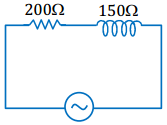
Impedance of the following circuit will be :
Alternating Current – NEET-5245
  1. A 150Ω
  2. B 200Ω
  3. C 250Ω
  4. D 340Ω
Show answer

Correct answer: C

8
At resonance in a series LCR circuit, which of the following statements is true: -
  1. A Current in the circuit is maximum and phase difference between E and I is $\pi / 2$
  2. B Current in the circuit is maximum and phase difference between E and I is zero
  3. C Voltage is maximum and phase difference between E and I is $\pi / 2$
  4. D Current is minimum and phase difference between E and I is zero
Show answer

Correct answer: B

9
L, C and R represent physical quantities inductance, capacitance and resistance respectively. The combination representing dimension of frequency is
  1. A LC
  2. B $( \mathrm { LC } ) ^ { - 1 / 2 }$
  3. C $\left( \frac { \mathrm { L } } { \mathrm { C } } \right) ^ { - 1 / 2 }$
  4. D $\frac { \mathrm { C } } { \mathrm { L } }$
Show answer

Correct answer: B

10
The inductive reactance of an inductive coil with $\frac { 1 } { \pi }$ henry and 50 Hz :-
  1. A $\frac { 50 } { \pi } \mathrm { ohm }$
  2. B $\frac { \pi } { 50 } \mathrm { ohm }$
  3. C 100 ohm
  4. D 50 ohm
Show answer

Correct answer: C

11
A capacitor of capacity C and reactance X if capacitance and frequency become double then reactance will be :-
  1. A 4X
  2. B $\frac { X } { 2 }$
  3. C $\frac { X } { 4 }$
  4. D 2X
Show answer & explanation

Correct answer: C

Use $X_{c}=\frac{1}{\omega C}$
12
200Ω resistance and 1 H inductance is connected in series with an A.C. circuit. The frequency of the source is $\frac { 200 } { 2 \pi } \mathrm {~Hz}$. Then phase difference in between V and I will be :-
  1. A $30 ^ { \circ }$
  2. B $60 ^ { \circ }$
  3. C $45 ^ { \circ }$
  4. D $90 ^ { \circ }$
Show answer

Correct answer: C

13
There is a 5Ω resistance in an A.C. circuit. Inductance of 0.1 H is connected with it in series. If equation of A.C. e.m.f. is V = 5 sin 50t then the phase difference between current and e.m.f. is :-
  1. A $\frac { \pi } { 2 }$
  2. B $\frac { \pi } { 6 }$
  3. C $\frac { \pi } { 4 }$
  4. D 0
Show answer

Correct answer: C

14
The impedence of a circuit, when a resistance R and an inductor of inductance L are connected in series in an A.C. circuit of frequency (f) is :-
  1. A $\sqrt { \mathrm { R } + 4 \pi \mathrm { fL } ^ { 2 } }$
  2. B $\sqrt { \mathrm { R } + 4 \pi ^ { 2 } \mathrm { f } ^ { 2 } \mathrm {~L} ^ { 2 } }$
  3. C $\sqrt { \mathrm { R } ^ { 2 } + 4 \pi ^ { 2 } \mathrm { f } ^ { 2 } \mathrm {~L} ^ { 2 } }$
  4. D $\sqrt { \mathrm { R } ^ { 2 } + 2 \pi ^ { 2 } \mathrm { f } ^ { 2 } \mathrm {~L} ^ { 2 } }$
Show answer

Correct answer: C

15
An inductance of 0.4 Henry and a resistance of 100 ohm are connected to a A.C. voltage source of 220 V and 50 Hz. Then find out the phase difference between the voltage and current flowing in the circuit :
  1. A $\tan ^ { - 1 } ( 2.25 \pi )$
  2. B $\tan ^ { - 1 } ( 0.4 \pi )$
  3. C $\tan ^ { - 1 } ( 1.5 \pi )$
  4. D $\tan ^ { - 1 } ( 0.5 \pi )$
Show answer & explanation

Correct answer: B

$\begin{array}{l}\mathrm{X}_{\mathrm{L}}=\omega \mathrm{L} \\ =2 \pi \times 50 \times 0.4 \\ =40 \pi \Omega \\ \mathrm{R}=100 \Omega\end{array}$
$\begin{array}{l}\tan \phi=\frac{\mathrm{X}_{\mathrm{L}}}{\mathrm{R}} \\ \tan \phi=\frac{40 \pi}{100} \\ \tan \phi=0.4 \pi \\ \phi=\tan ^{-1}(0.4 \pi)\end{array}$
16
If the current through an inductor of inductance L is given by $\mathrm { I } = \mathrm { I } _ { 0 } \sin \omega \mathrm { t }$, then the voltage across inductor will be :-
  1. A $\mathrm { I } _ { 0 } \omega \mathrm {~L} \sin ( \omega \mathrm { t } - \pi / 2 )$
  2. B $\mathrm { I } _ { 0 } \omega \mathrm {~L} \sin ( \omega t + \pi / 2 )$
  3. C $\mathrm { I } _ { 0 } \omega \mathrm {~L} \sin ( \omega t - \pi )$
  4. D None of these
Show answer & explanation

Correct answer: B

$\begin{aligned} V_{L}=L & \frac{d I}{d t}=L \frac{d}{d t}\left(I_{0} \sin \omega t\right) \\ & =I_{0} \omega L \cos \omega t=I_{0} \omega L \sin (\omega t+\pi / 2)\end{aligned}$
17
A series R-L-C ( $R = 10 \Omega , X _ { L } = 20 \Omega , X _ { C } = 20 \Omega$ ) circuit is supplied by $\mathrm { V } = 10 \sin \omega \mathrm { t }$ volt then power dissipation in circuit is :-
  1. A Zero
  2. B 10 W
  3. C 5 W
  4. D 2.5 W
Show answer & explanation

Correct answer: C

Alternating Current – NEET-5343
18
Frequency of A.C. in India is -
  1. A 45 Hz
  2. B 60 Hz
  3. C 50 Hz
  4. D None of the above
Show answer

Correct answer: C

19
A $110 \mathrm {~V} , 60 \mathrm {~W}$ lamp is run from a 220 V AC mains using a capacitor in series with the lamp, instead of a resistor then the voltage across the capacitor is about:-
  1. A 110 V
  2. B 190 V
  3. C 220 V
  4. D 311 V
Show answer & explanation

Correct answer: B

$\begin{array}{l}V^{2}=V_{R}^{2}+V_{C}^{2} \\ (220)^{2}=(110)^{2}+V_{C}^{2} \\ V_{C}=190 \text { Volt. }\end{array}$
20
In a series resonant R-L-C circuit, if L is increased by 25% and C is decreased by 20%, then the resonant frequency will :
  1. A Increase by 10%
  2. B Decrease by 10%
  3. C Remain unchanged
  4. D Increase by 2.5%
Show answer & explanation

Correct answer: C

$\begin{array}{l}\mathrm{f}=\frac{1}{2 \pi \sqrt{\mathrm{LC}}} \\ \text { Now } \mathrm{L}^{\prime}=\mathrm{L}+\frac{\mathrm{L}}{4}=\frac{5 \mathrm{~L}}{4} \\ \mathrm{C}^{\prime}=\mathrm{C}-\frac{\mathrm{C}}{5}=\frac{4 \mathrm{C}}{5} \\ \mathrm{f}^{\prime}=\frac{1}{2 \pi \sqrt{\mathrm{~L}^{\prime} \mathrm{C}^{\prime}}}=\frac{1}{2 \pi \sqrt{\frac{5 \mathrm{~L}}{4} \times \frac{4 \mathrm{C}}{5}}} \\ \mathrm{f}^{\prime}=\frac{1}{2 \pi \sqrt{\mathrm{LC}}}=\mathrm{f}\end{array}$

Attempt this as a timed test

Reading answers is not the same as sitting the paper. Attempt it timed and you get your score, per-question timing, and the mistakes tracked for revision.

Start free

More Alternating Current tests

All Alternating Current tests →