Dual Nature of Matter and Radiation — DPP 1

20 NEET questions from Dual Nature of Matter and Radiation, with answers and explanations. Attempt it as a timed test to get scoring, accuracy breakdown and mistake tracking.

Attempt this test free 20 questions · 30 minutes · +80 marks
1
Given that a photon of light of wavelength $10000 \AA$ has energy 1.23 eV. Now when light of intensity $I _ { 0 }$ and wavelength $5000 \AA$ falls on a photo cell the saturation current and stopping potential are 0.40 μA and 1.36 V, respectively. The work function is
  1. A 0.43 eV
  2. B 1.10 eV
  3. C 1.36 eV
  4. D 2.47 eV
Show answer & explanation

Correct answer: B

$\begin{array}{l}\lambda=10000 \AA \text { has } E=1.23 \mathrm{eV} \\ \because \quad \text { Energy of } 5000 \mathrm{~A} \text { photon }=2.46 \mathrm{eV} \\ 2.46=\phi+1.36 \\ \phi=1.1 \mathrm{eV}\end{array}$
2
If the energy of a photon is E, then its momentum is (c is velocity of light)
  1. A E/c
  2. B E/2c
  3. C 2E/c
  4. D It has no momentum
Show answer & explanation

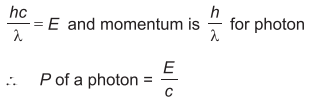
Correct answer: A

Dual Nature of Matter and Radiation – NEET-13481
3
When a point source of light is at a distance of 50 cm from a photoelectric cell, the cut-off voltage is found to be V$_{0}$. If the same source is placed at a distance of 1 m from the cell, then the cut-off voltage will be
  1. A $V _ { 0 } / 4$
  2. B $V _ { 0 } / 2$
  3. C $V _ { 0 }$
  4. D $2 V _ { 0 }$
Show answer & explanation

Correct answer: C

Stopping potential depends on incident light and will not change.
4
The photoelectric work function
  1. A Is different for different materials
  2. B Is same for all metals
  3. C Depends upon frequency of the incident light
  4. D Depends upon intensity of the incident light
Show answer & explanation

Correct answer: A

Work function is the property of material.
5
The wavelength of matter waves is independent of
  1. A Mass
  2. B Velocity
  3. C Momentum
  4. D Charge
Show answer & explanation

Correct answer: D

The wavelength of matter waves is given by $\lambda=\frac{h}{m v}$
Hence, it is independent of charge.
6
A photon and an electron both have wavelength $1 \AA$. The ratio of energy of photon to that of electron is
  1. A 1
  2. B 0.012
  3. C 82.7
  4. D $10 ^ { - 10 }$
Show answer & explanation

Correct answer: C

$\begin{array}{l}\mathrm{E}(\text { Photon })=\frac{h c}{\lambda} \\ \mathrm{E}(\text { electron })=\frac{P^{2}}{2 m_{e}}=\left(\frac{h}{\lambda}\right)^{2} \frac{1}{2 m_{e}}\end{array}$
7
Threshold wavelength for sodium is $6 \times 10 ^ { - 7 } \mathrm {~m}$. Then photoemission occurs for light of wavelength λ if
  1. A $\lambda > 6 \times 10 ^ { - 7 }$ metre
  2. B $\lambda < 6 \times 10 ^ { - 7 }$ metre
  3. C $\lambda = 5 \times 10 ^ { 14 }$ metre
  4. D Frequency $\leq 5 \times 10 ^ { 14 } \mathrm {~Hz}$
Show answer & explanation

Correct answer: B

$\lambda \leq \lambda_{\text {threshold }}$
8
Light of frequency 1.5 times the threshold frequency is incident on photo-sensitive material. If the frequency is halved and intensity is doubled, the photo current becomes
  1. A Quadrupled
  2. B Doubled
  3. C Halved
  4. D Zero
Show answer & explanation

Correct answer: D

If frequency is halved, the initial frequency will become less than incident frequency.
9
When photon of energy 3.8 eV falls on metallic surface of work function 2.8 eV , then the kinetic energy of emitted electrons are
  1. A 1 eV
  2. B 6.6 eV
  3. C 0 to 1 eV
  4. D 2.8 eV
Show answer & explanation

Correct answer: C

$\begin{array}{l}h v=w_{0}+\mathrm{KE}_{\max } \\ 3.8-2.8=\mathrm{KE}_{\max } \\ \therefore \quad \mathrm{KE}_{\max }=1 \mathrm{eV}\end{array}$
10
In photoelectric effect, the slope of stopping potential versus frequency of incident light for a given surface will be
  1. A $h e ^ { - 1 }$
  2. B eh
  3. C e
  4. D h
Show answer & explanation

Correct answer: A

$V_{0}=\frac{h}{e} f-\frac{w_{0}}{e}$
11
The energy of the most energetic photoelectrons emitted from a metal target depends upon
  1. A Threshold frequency of the metal
  2. B Photoelectric work function of the metal
  3. C Wavelength of the incident radiation
  4. D All of these
Show answer & explanation

Correct answer: D

$h v-w_{0}=\mathrm{KE}_{\max }$
Hence, all options are correct.
12
A monochromatic point source of light is placed at a distance d from a metal surface. Photo electrons are ejected at a rate n per second, and with maximum kinetic energy E. If the source is brought nearer to distance d/2, the rate and the maximum kinetic energy per photoelectron become nearly
  1. A 2n and 2E
  2. B 4n and 4E
  3. C 4n and E
  4. D n and 4E
Show answer & explanation

Correct answer: C

Intensity $\propto \frac{1}{d^{2}}$
So when the source of light is brought closer
Intensity becomes 4 times.
Hence, rate ∝ Intensity the rate will become 4n.
$\mathrm{KE}_{\max }$ depends on incident frequency which does not change and will remain E.
13
If the frequency of light incident on a metallic plate be doubled, how will the maximum kinetic energy of the photoelectrons change?
  1. A It becomes more than double
  2. B It becomes less than double
  3. C It becomes exactly double
  4. D It does not change
Show answer & explanation

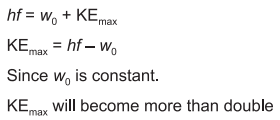
Correct answer: A

Dual Nature of Matter and Radiation – NEET-13477
14
In photoelectric effect when photons of energy hv fall on a photosensitive surface (work function $h v _ { 0 }$ ) electrons are emitted from the metallic surface. It is possible to say that
  1. A All ejected electrons have same kinetic energy equal to $h v - h v _ { 0 }$
  2. B The ejected electrons have a distribution of kinetic energy from zero to ( $h \nu - h \nu _ { 0 }$ )
  3. C The most energetic electrons have kinetic energy equal to $h v$
  4. D All ejected electrons have kinetic energy $h v _ { 0 }$
Show answer & explanation

Correct answer: B

$\mathrm{KE}_{\max }=h v-h v_{0}$ and hence the energies of electrons can range anywhere between these values.
15
The phenomenon of photoelectric effect was first explained by
  1. A Hallwach
  2. B Einstein
  3. C Planck
  4. D Bohr
Show answer & explanation

Correct answer: B

Einstein won the Nobel Prize for predicting photoelectric effect by proposing the dual nature of light.
16
The ratio of specific charge e/m of a proton to that of an α-particle is
  1. A 1 : 4
  2. B 1 : 2
  3. C 4 : 1
  4. D 2 : 1
Show answer & explanation

Correct answer: D

Charge by mass ratio of proton $=\frac{e}{m_{P}}$
Charge by mass ratio of $\alpha$ particle $=\frac{2 e}{4 m_{P}}$
∴ Ratio of specific charge = 2 : 1
17
The work function of a substance is 4eV. The longest wavelength of light that can cause the emission of photoelectrons from this substance is approximately
  1. A 540 nm
  2. B 400 nm
  3. C 310 nm
  4. D 220 nm
Show answer & explanation

Correct answer: C

$\phi=\frac{h c}{\lambda_{0}}$
18
Which one of the following statements is not true about de-Broglie waves?
  1. A All atomic particles in motion have waves of a definite wavelength associated with them
  2. B Higher the momentum, the longer is the wave-length
  3. C Faster the particle, the shorter is the wavelength
  4. D For the same velocity, a heavier particle has a shorter wavelength
Show answer & explanation

Correct answer: B

$\lambda=\frac{h}{P}$.
Hence, higher the momentum shorter is the wavelength.
19
Wavelength of an electron accelerated through a potential difference of 1 volt is
  1. A $12.27 \AA$
  2. B $1.234 \AA$
  3. C 1 micron
  4. D 1 fermi
Show answer & explanation

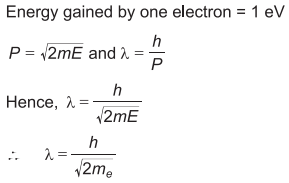
Correct answer: A

Dual Nature of Matter and Radiation – NEET-13484
20
The cathode of a photocell is changed such that the work function changes from w$_{1}$ to w$_{2}$ (w$_{2}$ > w$_{1}$). If the saturation currents before and after the change are I$_{1}$ and I$_{2}$ and all other conditions are unchanged, then (assuming hv > w$_{2}$)
  1. A $I _ { 1 } = I _ { 2 }$
  2. B $I _ { 1 } < I _ { 2 }$
  3. C $I _ { 1 } > I _ { 2 }$
  4. D $I _ { 1 } < I _ { 2 } < 2 I _ { 2 }$
Show answer & explanation

Correct answer: A

Saturation current depends on intensity which does not change.
Hence, $I_{1}=I_{2}$

Attempt this as a timed test

Reading answers is not the same as sitting the paper. Attempt it timed and you get your score, per-question timing, and the mistakes tracked for revision.

Start free

More Dual Nature of Matter and Radiation tests

All Dual Nature of Matter and Radiation tests →