Dual Nature of Matter and Radiation — DPP 2

20 NEET questions from Dual Nature of Matter and Radiation, with answers and explanations. Attempt it as a timed test to get scoring, accuracy breakdown and mistake tracking.

Attempt this test free 20 questions · 30 minutes · +80 marks
1
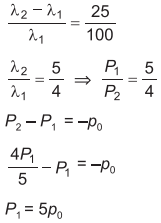
The de Broglie wavelength λ associated with a proton increases by 25%, if its momentum is decreased by $p _ { 0 }$. The initial momentum was
  1. A $4 p _ { 0 }$
  2. B $\frac { p _ { 0 } } { 4 }$
  3. C $5 p _ { 0 }$
  4. D $\frac { p _ { 0 } } { 5 }$
Show answer & explanation

Correct answer: C
Dual Nature of Matter and Radiation – NEET-13491
2
The linear momentum of a 6 MeV photon is
  1. A $1 \times 10 ^ { - 2 } \mathrm { eV } - \mathrm { s } / \mathrm { m }$
  2. B $0.5 \times 10 ^ { - 2 } \mathrm { eV } - \mathrm { s } / \mathrm { m }$
  3. C $2 \times 10 ^ { - 2 } \mathrm { eV } - \mathrm { s } / \mathrm { m }$
  4. D $4 \times 10 ^ { - 2 } \mathrm { eV } - \mathrm { s } / \mathrm { m }$
Show answer & explanation

Correct answer: C
$\begin{aligned} P & =\frac{E}{c}=\frac{6 \times 10^{6} \mathrm{eV}}{3 \times 10^{8} \mathrm{~m} / \mathrm{s}} \\ & =2 \times 10^{-2} \mathrm{eV}-\mathrm{s} / \mathrm{m}\end{aligned}$
3
Photoelectrons from metal do not come out with same energy. Most appropriate explanation is
  1. A Some electrons loose energy in form of heat
  2. B Work function of a metal is average energy required to pull out electrons
  3. C Electrons in metal occupy different energy levels and work function is the minimum energy required for electron in highest level of conduction band to get out of metal
  4. D For some electrons, some part of energy gained during inelastic collision with photon is spent in over coming attractive force by nucleus
Show answer

Correct answer: C

4
The photoelectric threshold for a certain metal surface is $330 \AA$. What is the maximum kinetic energy of the photoelectrons emitted, if radiations of wavelength $1100 \AA$ are used?
  1. A 1 eV
  2. B 2 eV
  3. C 7.5 eV
  4. D No electron is emitted
Show answer & explanation

Correct answer: D

Since λ incident is greater than threshold wavelength. No electron will be ejected.
5
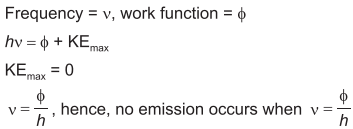
If the work function of a metal is 'Φ' and the frequency of the incident light is 'v', there is no emission of photo electron for
  1. A $v < \frac { \phi } { h }$
  2. B $v = \frac { \phi } { h }$
  3. C $v > \frac { \phi } { h }$
  4. D $\mathrm { v } > = < \frac { \phi } { h }$
Show answer & explanation

Correct answer: A

Dual Nature of Matter and Radiation – NEET-13608
6
The speed of electron having wavelength $1.2 \times 10 ^ { - 9 } \mathrm {~m}$ is about
  1. A $6 \times 10 ^ { 5 } \mathrm {~m} / \mathrm { s }$
  2. B $4 \times 10 ^ { 6 } \mathrm {~m} / \mathrm { s }$
  3. C $5 \times 10 ^ { 6 } \mathrm {~m} / \mathrm { s }$
  4. D $3 \times 10 ^ { 6 } \mathrm {~m} / \mathrm { s }$
Show answer & explanation

Correct answer: A

$\lambda=\frac{h}{m v} \Rightarrow v=\frac{h}{m \lambda}$
7
If the threshold wavelength for a metal is $6200 \AA$ then minimum energy required to eject an electron from the surface of metal is (nearly)
  1. A 1 eV
  2. B 2 eV
  3. C 0.5 eV
  4. D 0.8 eV
Show answer & explanation

Correct answer: B

$W_{f}=\frac{h C}{\lambda_{0}}=\frac{12400}{6200}=2 \mathrm{eV}$
8
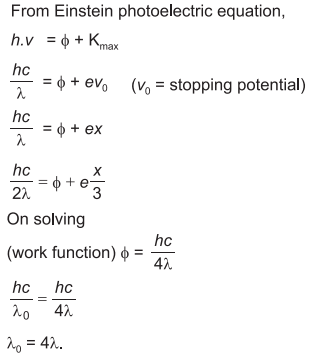
When a metallic surface is illuminated with light of wavelength λ, the stopping potential is x volt. When the same surface is illuminated by light of wavelength 2λ, the stopping potential is $\frac { x } { 3 }$. Threshold wavelength for the metallic surface is
  1. A $\frac { 4 \lambda } { 3 }$
  2. B 4λ
  3. C 6λ
  4. D $\frac { 8 \lambda } { 3 }$
Show answer & explanation

Correct answer: B

Dual Nature of Matter and Radiation – NEET-13473
9
If work function of target material is 2.34 eV and wavelength of incident light is $4.36 \times 10 ^ { - 7 } \mathrm {~m}$ then minimum potential required to stop the photo current is about ($h = 6.6 \times 10 ^ { - 34 } \mathrm { Js }$)
  1. A 1.5 V
  2. B 0.5 V
  3. C 2 V
  4. D Zero
Show answer & explanation

Correct answer: B

$\begin{aligned} V & =\frac{1}{e}\left(\frac{12400}{4360}-2.34\right) \mathrm{eV} \\ V & =\frac{0.5 \mathrm{eV}}{e}=0.5 \mathrm{~V}\end{aligned}$
10
The number of photo-electrons emitted per second from a metal surface increases when
  1. A Energy of incident photon increases
  2. B The frequency of incident light increases
  3. C Wavelength of incident light increases
  4. D Intensity of incident light increases
Show answer & explanation

Correct answer: D

No. of photoelectrons ∝ intensity
11
Neglecting variation of mass with velocity, the wavelength associated with an electron having a kinetic energy E is proportional to
  1. A $E ^ { 1 / 2 }$
  2. B E
  3. C $E ^ { - 1 / 2 }$
  4. D $E ^ { - 2 }$
Show answer & explanation

Correct answer: C
$\begin{array}{l}\lambda=\frac{h}{\sqrt{2 m E}} \\ \therefore \quad \lambda \propto E^{-1 / 2}\end{array}$
12
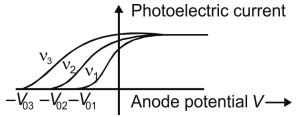
In photoelectric effect, the curve between photoelectric current and anode potential V (for different frequencies) is shown in figure, then
Dual Nature of Matter and Radiation – NEET-13465
  1. A $v _ { 1 } > v _ { 2 } > v _ { 3 }$
  2. B $v _ { 1 } < v _ { 2 } < v _ { 3 }$
  3. C $v _ { 1 } = v _ { 2 } = v _ { 3 }$
  4. D $v _ { 1 } > v _ { 2 } < v _ { 3 }$
Show answer & explanation

Correct answer: B

As is evident from the graph v$_{1}$ < v$_{2}$ < v$_{3}$, V$_{01}$, V$_{02}$, V$_{03}$ in this case are the stopping potential.
13
The kinetic energy of a particle is increased to 16 times. The percentage change in de-Broglie wavelength of the particle is
  1. A -25%
  2. B -50%
  3. C -75%
  4. D -100%
Show answer & explanation

Correct answer: C
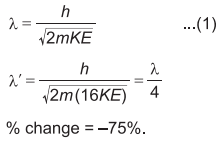
Dual Nature of Matter and Radiation – NEET-13560
14
If alpha particle and deutron are moving with same velocity, the ratio of their respective de-Broglie wavelength will be
  1. A 1 : 1
  2. B $1 : \sqrt { 2 }$
  3. C $\sqrt { 3 } : 1$
  4. D 1 : 2
Show answer & explanation

Correct answer: D

$\frac{\lambda_{\text {alpha }}}{\lambda_{\text {deutron }}}=\frac{m_{\text {deutron }}}{m_{\text {alpha }}}=1: 2$
15
Wave nature of light cannot explain photoelectric effect because in photoelectric effect, it is seen that
  1. A For the frequency of light below a certain value, the photoelectric effect does not take place, irrespective of intensity
  2. B Maximum kinetic energy of ejected electrons is independent of intensity of radiation
  3. C There is no time lag between the incidence of radiation and emission of electrons
  4. D All of these
Show answer & explanation

Correct answer: D

Laws of photoelectric emission
16
If the kinetic energy of a proton gets doubled, then the de-Broglie wavelength associated with it change by a factor
  1. A $\frac { 1 } { 2 }$
  2. B $\frac { 1 } { 3 }$
  3. C $\sqrt { 2 }$
  4. D $\frac { 1 } { \sqrt { 2 } }$
Show answer & explanation

Correct answer: D

Dual Nature of Matter and Radiation – NEET-13565
17
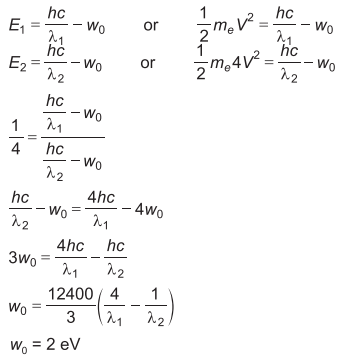
A photosensitive metallic surface is illuminated alternately with lights of wavelength $3100 \AA$ and $6200 \AA$. It is observed that maximum speeds of the photoelectrons in two cases are in ratio 2 : 1. The work function of the metal is (hc = 12400 eVA)
  1. A 1 eV
  2. B 2 eV
  3. C $\frac { 4 } { 3 } \mathrm { eV }$
  4. D $\frac { 2 } { 3 } \mathrm { eV }$
Show answer & explanation

Correct answer: C
Dual Nature of Matter and Radiation – NEET-13610
18
Work function of a material depends on
  1. A Nature of material
  2. B Wavelength of incident light
  3. C Frequency of incident light
  4. D Intensity of incident light
Show answer & explanation

Correct answer: A

Work function of a material depends on nature of material.
19
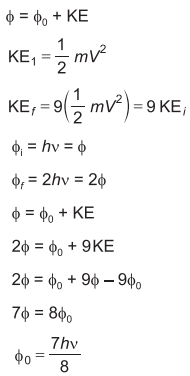
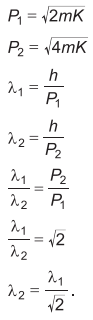
The velocity of most energetic electron emitted from a metallic surface is tripled when the frequency v of the incident radiation is doubled. The work function of this metal will be (h is Planck's constant)
  1. A $\frac { 5 h v } { 8 }$
  2. B $\frac { 3 h v } { 8 }$
  3. C $\frac { 7 h v } { 8 }$
  4. D $\frac { h v } { 4 }$
Show answer & explanation

Correct answer: C
Dual Nature of Matter and Radiation – NEET-13567
20
Photoelectric effect can be explained by
  1. A Particle nature of light
  2. B Snell's law of light
  3. C Wave nature of light
  4. D Both (A) and (B)
Show answer & explanation

Correct answer: A

Light is in form of energy packets.

Attempt this as a timed test

Reading answers is not the same as sitting the paper. Attempt it timed and you get your score, per-question timing, and the mistakes tracked for revision.

Start free

More Dual Nature of Matter and Radiation tests

All Dual Nature of Matter and Radiation tests →