Dual Nature of Matter and Radiation — DPP 3

20 NEET questions from Dual Nature of Matter and Radiation, with answers and explanations. Attempt it as a timed test to get scoring, accuracy breakdown and mistake tracking.

Attempt this test free 20 questions · 30 minutes · +80 marks
1
The de Broglie wavelength of an electron in the $n ^ { \text {th } }$ Bohr orbit is related to the radius R of the orbit as
  1. A $n \lambda = \pi R$
  2. B $n \lambda = \frac { 3 } { 2 } \pi R$
  3. C $n \lambda = 2 \pi R$
  4. D $n \lambda = 4 \pi R$
Show answer & explanation

Correct answer: C

$n \lambda=2 \pi R$ (According to Bohr's theory)
2
For a proton accelerated through potential difference of one volt, kinetic energy gained in eV is
  1. A 1
  2. B 1840
  3. C $\frac { 1 } { 1840 }$
  4. D $931.5 \times 10 ^ { - 6 }$
Show answer & explanation

Correct answer: A

Kinetic energy = qV
For one electron energy gained is therefore = 1 eV
3
Ultraviolet radiations of 6.2 eV fall on an aluminium surface (work function 4.2 eV). The kinetic energy (in joule) of the fastest electron emitted is approximately
  1. A $3.2 \times 10 ^ { - 21 }$
  2. B $3.2 \times 10 ^ { - 19 }$
  3. C $3.2 \times 10 ^ { - 17 }$
  4. D $3.2 \times 10 ^ { - 15 }$
Show answer & explanation

Correct answer: B

Energy incident = 6.2 eV
Work function = 4.2 eV
KEmax = Energy incident - Work function = 2 eV = 3.2 × 10$^{-19}$ J
4
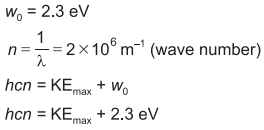
The work function of a certain metal is 2.3 eV. If light of wave number $2 \times 10 ^ { 6 } \mathrm {~m} ^ { - 1 }$ falls on it, the kinetic energies of fastest and slowest ejected electron will be respectively
  1. A 2.48 eV, 0.18 eV
  2. B 0.18 eV , zero
  3. C 2.30 eV , 0.18 eV
  4. D 0.18 eV , 0.18 eV
Show answer & explanation

Correct answer: B

Dual Nature of Matter and Radiation – NEET-13616
5
Choose the only correct statement out of the following
  1. A Only a charged particle in motion is accompanied by matter waves
  2. B Only subatomic particles in motion are accompanied by matter waves
  3. C Any particle in motion, whether charged or uncharged, is accompanied by matter waves
  4. D No particle, whether at rest or in motion, is ever accompanied by matter waves
Show answer

Correct answer: C

6
How many photons are emitted by a laser source of $5 \times 10 ^ { - 3 } \mathrm {~W}$ operating at 632.2 nm in 2 s? ($h = 6.63 \times 10 ^ { - 34 } \mathrm {~J} \mathrm {~s}$)
  1. A $3.2 \times 10 ^ { 16 }$
  2. B $1.6 \times 10 ^ { 16 }$
  3. C $4 \times 10 ^ { 16 }$
  4. D $0.4 \times 10 ^ { 16 }$
Show answer & explanation

Correct answer: A

$\begin{array}{l}\text { Number of photons per second }=\frac{\text { Total energy emitted/second }}{\text { Energy of one photon }} \\ \text { Energy of one photon }=\frac{h c}{\lambda}=\frac{h c}{632.2 \times 10^{-9}} \\ \text { Energy per second emitted }=5 \times 10^{-3} \mathrm{~W} \\ \text { Total number of photons }=\text { Photons emitted per second × Time }\end{array}$
7
In photoelectric effect, if a weak intensity radiation instead of strong intensity of suitable frequency is used then
  1. A Photoelectric effect will get delayed
  2. B Photoelectric effect will not take place
  3. C Maximum kinetic energy will decrease
  4. D Saturation current will decrease
Show answer & explanation

Correct answer: D

Saturation current which depends on intensities will decrease.
8
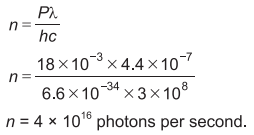
Monochromatic light of wavelength 440 nm is produced. The power emitted by light is 18 mW. The number of photons emitted per second by light beam is ($h = 6.6 \times 10 ^ { - 34 } \mathrm { Js }$)
  1. A $3 \times 10 ^ { 16 }$
  2. B $4 \times 10 ^ { 16 }$
  3. C $3 \times 10 ^ { 18 }$
  4. D $4 \times 10 ^ { 18 }$
Show answer & explanation

Correct answer: B

Dual Nature of Matter and Radiation – NEET-13570
9
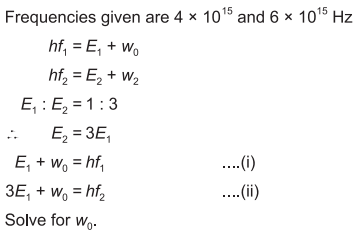
When the electromagnetic radiations of frequencies $4 \times 10 ^ { 15 } \mathrm {~Hz}$ and $6 \times 10 ^ { 15 } \mathrm {~Hz}$ fall on the same metal in different experiments, the ratio of maximum kinetic energy of electrons liberated is 1 : 3. The threshold frequency for the metal is
  1. A $2 \times 10 ^ { 15 } \mathrm {~Hz}$
  2. B $1 \times 10 ^ { 15 } \mathrm {~Hz}$
  3. C $3 \times 10 ^ { 15 } \mathrm {~Hz}$
  4. D $1.67 \times 10 ^ { 15 } \mathrm {~Hz}$
Show answer & explanation

Correct answer: C

Dual Nature of Matter and Radiation – NEET-13617
10
The wavelength of matter wave is independent of
  1. A Charge
  2. B Mass
  3. C Velocity
  4. D All of these
Show answer & explanation

Correct answer: A

$\lambda=\frac{h}{m v}$
11
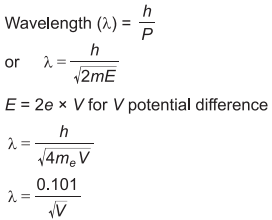
For a proton accelerated through V volts, de Broglie wavelength is given as λ = ________
  1. A $\frac { 12.27 } { \sqrt { V } } \AA$
  2. B $\frac { 0.101 } { \sqrt { V } } \AA$
  3. C $\frac { 0.286 } { \sqrt { V } } \AA$
  4. D $\frac { 12400 } { V } \AA$
Show answer & explanation

Correct answer: C

Energy gained by proton = 1 eV
$\lambda=\frac{h}{\sqrt{2 m E}} \text { or } \lambda=\frac{h}{\sqrt{2 m}} \times \frac{1}{\sqrt{V}}$
12
The energy of a photon of wavelength λ is given by
  1. A hλ
  2. B chλ
  3. C $\frac { \lambda } { h c }$
  4. D $\frac { h c } { \lambda }$
Show answer & explanation

Correct answer: D

Energy of a photon $=\frac{h c}{\lambda}$
13
Which of the following statements is not correct?
  1. A Photographic plates are sensitive to infrared rays
  2. B Photographic plates are sensitive to ultraviolet rays
  3. C Infrared rays are invisible but can cast shadows like visible light
  4. D Infrared photons have more energy than photons of visible light
Show answer & explanation

Correct answer: D

Infrared photons have less frequency than visible light. Hence, they have less energy.
14
Choose the correct graph of intensity of incident light and photocurrent.
  1. A
  2. B
  3. C
  4. D
Show answer & explanation

Correct answer: A

Photocurrent ∝ Intensity of light
15
For an alpha particle, accelerated through a potential difference V, wavelength (in $\dot { A }$ ) of the associated matter wave is
  1. A $\frac { 12.27 } { \sqrt { V } }$
  2. B $\frac { 0.101 } { \sqrt { V } }$
  3. C $\frac { 0.202 } { \sqrt { V } }$
  4. D $\frac { 0.286 } { \sqrt { V } }$
Show answer & explanation

Correct answer: B

Dual Nature of Matter and Radiation – NEET-13631
16
Find the number of electrons emitted per second by a 24 W source of monochromatic light of wavelength $6600 \AA$, assuming 3% efficiency for photoelectric effect (take $h = 6.6 \times 10 ^ { - 34 } \mathrm { Js }$ )
  1. A $48 \times 10 ^ { 19 }$
  2. B $48 \times 10 ^ { 17 }$
  3. C $8 \times 10 ^ { 19 }$
  4. D $24 \times 10 ^ { 17 }$
Show answer & explanation

Correct answer: D

$\begin{array}{l}\text { Energy per photon }=h f \text { or } \frac{h c}{\lambda} \\ \text { Number of photon's per second }=\frac{24}{h f} \\ \text { Number of electrons emitted }=\frac{3}{100} \times \frac{24}{h c} \times \lambda\end{array}$
17
Variation of momentum of particle (p) with associated de-Broglie wavelength (λ) is shown correctly by
  1. A
  2. B
  3. C
  4. D
Show answer & explanation

Correct answer: A

$\lambda=\frac{h}{P}$ which is a hyperbolic graph like(1).
18
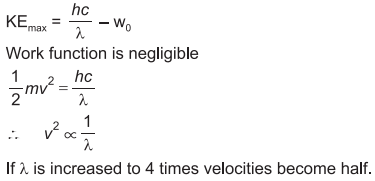
Assuming photo-emission to take place, the factor by which the maximum velocity of the emitted photo electrons changes when the wavelength of the incident radiation is increased four times, is (assuming work function to be negligible in comparison to hc/λ)
  1. A 4
  2. B $\frac { 1 } { 4 }$
  3. C 2
  4. D $\frac { 1 } { 2 }$
Show answer & explanation

Correct answer: D

Dual Nature of Matter and Radiation – NEET-13613
19
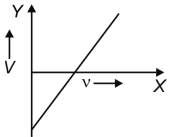
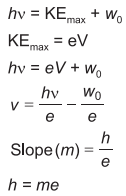
The stopping potential V for photo-electric emission from a metal surface is plotted along Y-axis and frequency v of incident light along X-axis. A straight line is obtained as shown. Planck's constant is given by
Dual Nature of Matter and Radiation – NEET-13614
  1. A Slope of the line
  2. B Product of slope on the line and charge on the electron
  3. C Product of intercept along Y-axis and mass of the electron
  4. D Product of slope and mass of electron
Show answer & explanation

Correct answer: B

Dual Nature of Matter and Radiation – NEET-13614
20
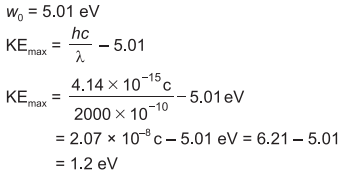
The work function of a metallic surface is 5.01 eV. The photo electrons are emitted when light of wavelength $2000 \AA$ falls on it. The potential difference applied to stop the fastest photo electrons is $\left[ h = 4.14 \times 10 ^ { - 15 } \mathrm { eV } \mathrm { s } \right]$
  1. A 1.2 V
  2. B 2.24 V
  3. C 3.6 V
  4. D 4.8 V
Show answer & explanation

Correct answer: A

Dual Nature of Matter and Radiation – NEET-13612

Attempt this as a timed test

Reading answers is not the same as sitting the paper. Attempt it timed and you get your score, per-question timing, and the mistakes tracked for revision.

Start free

More Dual Nature of Matter and Radiation tests

All Dual Nature of Matter and Radiation tests →