Electric Charges and Fields — DPP 1

20 NEET questions from Electric Charges and Fields, with answers and explanations. Attempt it as a timed test to get scoring, accuracy breakdown and mistake tracking.

Attempt this test free 20 questions · 30 minutes · +80 marks
1
Two identical small bodies each of mass m and charge q are suspended from two strings each of length l from a fixed point. This whole system is taken into an orbiting artificial satellite, then tension in the strings is:
  1. A $\frac { K q ^ { 2 } } { l ^ { 2 } } + 2 \mathrm { mg }$
  2. B $\frac { K q ^ { 2 } } { 4 l ^ { 2 } } + 2 \mathrm { mg }$
  3. C $\frac { K q ^ { 2 } } { l ^ { 2 } }$
  4. D $\frac { K q ^ { 2 } } { 4 l ^ { 2 } }$
Show answer

Correct answer: D
2
A charge produces an electric field of 1 N/C at a distance of 0.1 m from it. The magnitude of charge is;
  1. A $1.11 \times 10 ^ { - 12 } \mathrm { C }$
  2. B $9.11 \times 10 ^ { - 12 } \mathrm { C }$
  3. C $7.11 \times 10 ^ { - 6 } \mathrm { C }$
  4. D $6.11 \times 10 ^ { - 14 } \mathrm { C }$
Show answer

Correct answer: A

3
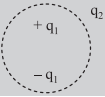
Consider the charge configuration and a spherical Gaussian surface as shown in the figure. When calculating the flux of the electric field over the spherical surface, the electric field will be due to
Electric Charges and Fields – NEET-19549
  1. A $q _ { 2 }$
  2. B Only the positive charges
  3. C All the charge
  4. D $+ q _ { 1 }$ and $- q _ { 1 }$
Show answer

Correct answer: C

4
Which one of the following statement regarding electrostatics is wrong?
  1. A Charge is quantized
  2. B Charge is conserved
  3. C There is an electric field near an isolated charge at rest
  4. D A stationary charge produces both electric and magnetic fields
Show answer

Correct answer: D

5
In nature, the electric charge of any system is always equal to;
  1. A half integral multiple of the least amount of charge
  2. B zero
  3. C one third of the least amount of charge
  4. D integral multiple of the least amount of charge
Show answer

Correct answer: D

6
A charge particle $q _ { 1 }$ is at position (2, -1, 3). The electrostatic force on another charged particle $q _ { 2 }$ at (0, 0, 0) is
  1. A $\frac { q _ { 1 } q _ { 2 } } { 56 \pi \epsilon _ { 0 } } ( 2 \hat { i } - \hat { j } + 3 \hat { k } )$
  2. B $\frac { q _ { 1 } q _ { 2 } } { 56 \sqrt { 14 } \pi \epsilon _ { 0 } } ( - 2 \hat { i } + \hat { j } - 3 \hat { k } )$
  3. C $\frac { q _ { 1 } q _ { 2 } } { 56 \sqrt { 14 } \pi \epsilon _ { 0 } } ( \hat { j } - 2 \hat { i } - 3 \hat { k } )$
  4. D $\frac { \mathrm { q } _ { 1 } \mathrm { q } _ { 2 } } { 14 \pi \epsilon _ { 0 } } ( \hat { \mathrm { i } } - 2 \hat { \mathrm { j } } + \hat { \mathrm { k } } )$
Show answer

Correct answer: B

7
Consider two concentric spherical surface $S _ { 1 }$ with radius R and $S _ { 2 }$ with radius 2R both centered at the origin. There is a charge +2q at the origin and there are no other charges. Compare the flux $\phi _ { 1 }$ through $S _ { 1 }$ with the flux $\phi _ { 2 }$ through $S _ { 2 }$.
  1. A $\phi _ { 1 } = 2 \phi _ { 2 }$
  2. B $\phi _ { 1 } = 4 \phi _ { 2 }$
  3. C $\phi _ { 1 } = \phi _ { 2 }$
  4. D $\phi _ { 1 } = \frac { \phi _ { 2 } } { 2 }$
Show answer

Correct answer: C

8
Find the number of electrons that should be removed from a coin so that it acquires a charge of $10 ^ { - 6 }$ coulomb.
  1. A $6.25 \times 10 ^ { 11 }$
  2. B $1.6 \times 10 ^ { 6 }$
  3. C $1.6 \times 10 ^ { - 19 }$
  4. D $6.25 \times 10 ^ { 12 }$
Show answer

Correct answer: D

9
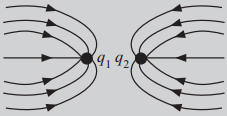
The given figure gives the electric lines of force due to two charges q$_{1}$ and q$_{2}$. What are the signs of the two charges?
Electric Charges and Fields – NEET-19543
  1. A q$_{1}$ is positive but q$_{2}$ is negative
  2. B q$_{1}$ is negative but q$_{2}$ is positive
  3. C Both are negative
  4. D Both are positive
Show answer

Correct answer: C

10
The magnitude of electric field intensity E is such that an electron placed in it would experience an electrical force equal to its weight is given by:
  1. A mge
  2. B $\frac { m g } { e }$
  3. C $\frac { e } { m g }$
  4. D $\frac { e ^ { 2 } } { m ^ { 2 } } g$
Show answer

Correct answer: B

11
A hollow metal sphere of a radius R is uniformly charged. The electric field due to the sphere at a distance r from the centre:
  1. A increases as r increases for r < R and for r > R
  2. B zero as r increases for r < R, decreases as r increases for r > R
  3. C zero as r increases for r < R, increases as r increases for r > R
  4. D decreases as r increases for r < R and for r > R
Show answer

Correct answer: B

12
Two point charges +4q and +q are separated by distance r, where should a third point charge Q be placed that the whole system remains in equilibrium?
  1. A $\frac { 2 r } { 3 }$ from q
  2. B $\frac { r } { 3 }$ from q
  3. C $\frac { r } { 2 }$ from q
  4. D $\frac { r } { 3 }$ from 4q
Show answer

Correct answer: B

13
If two identical spheres having charges 16 μC and -8 μC are kept at a certain distance apart, the force acting on them is F. They are touched and again kept at the same distance, the force now becomes;
  1. A F
  2. B $\frac { F } { 18 }$
  3. C $\frac { F } { 8 }$
  4. D $\frac { F } { 2 }$
Show answer

Correct answer: C

14
Which of the following option is correct?
  1. A The total number of charged particles in the universe remains conserved.
  2. B The magnitude of total positive charge of the universe is constant.
  3. C The magnitude of total negative charge of the universe is constant.
  4. D The total charge of the universe is constant.
Show answer

Correct answer: D

15
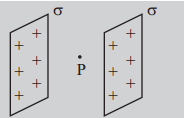
Find electric field due to given arrangement of infinite plane sheets at point P
Electric Charges and Fields – NEET-19550
  1. A 0
  2. B $\frac { \sigma } { \varepsilon _ { 0 } }$
  3. C $\frac { \sigma } { 2 \varepsilon _ { 0 } }$
  4. D $\frac { 2 \sigma } { \varepsilon _ { 0 } }$
Show answer

Correct answer: A

16
The weight of a body which is charged negatively by rubbing;
  1. A Remain constant
  2. B Decreases
  3. C Increases
  4. D May increase or may decrease
Show answer

Correct answer: C

17
Two identical small conducting spheres, having charges of opposite sign, attract each other with a force of 0.108 N when separated by 0.5 m. The spheres are connected by a conducting wire, which is then removed, and thereafter, they repel each other with a force of 0.036 N. The initial charges on the spheres are
  1. A $\pm 5 \times 10 ^ { - 6 } \mathrm { C }$ and $\pm 15 \times 10 ^ { - 6 } \mathrm { C }$
  2. B $\pm 1.0 \times 10 ^ { - 6 } \mathrm { C }$ and $\pm 3.0 \times 10 ^ { - 6 } \mathrm { C }$
  3. C $\pm 2.0 \times 10 ^ { - 6 } \mathrm { C }$ and $\pm 6.0 \times 10 ^ { - 6 } \mathrm { C }$
  4. D $\pm 0.5 \times 10 ^ { - 6 } \mathrm { C }$ and $\pm 1.5 \times 10 ^ { - 6 } \mathrm { C }$
Show answer

Correct answer: B

18
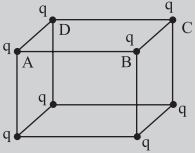
Eight point charges (can be assumed as small spheres uniformly charged and their centres at the corner of the cube) having values q each are fixed at vertices of a cube. The electric flux through square surface ABCD of the cube is:
Electric Charges and Fields – NEET-19548
  1. A $\frac { q } { 24 \epsilon _ { 0 } }$
  2. B $\frac { q } { 12 \epsilon _ { 0 } }$
  3. C $\frac { q } { 6 \in _ { 0 } }$
  4. D $\frac { q } { 8 \epsilon _ { 0 } }$
Show answer

Correct answer: C

19
The electric field due to a dipole at a distance $r$ on its axis;
  1. A directly proportional to $r ^ { 3 }$
  2. B inversely proportional to $r ^ { 3 }$
  3. C directly proportional to $r ^ { 2 }$
  4. D inversely proportional to $r ^ { 2 }$
Show answer

Correct answer: B

20
If a glass rod is rubbed with silk, it acquires a positive charge because;
  1. A protons are added to it
  2. B protons are removed from it
  3. C electrons are added to it
  4. D electrons are removed from it
Show answer

Correct answer: D

Attempt this as a timed test

Reading answers is not the same as sitting the paper. Attempt it timed and you get your score, per-question timing, and the mistakes tracked for revision.

Start free

More Electric Charges and Fields tests

All Electric Charges and Fields tests →