Electric Charges and Fields — DPP 3

20 NEET questions from Electric Charges and Fields, with answers and explanations. Attempt it as a timed test to get scoring, accuracy breakdown and mistake tracking.

Attempt this test free 20 questions · 30 minutes · +80 marks
1
In which of the following cases the electric field at the centre is not zero?
  1. A
  2. B
  3. C
  4. D (Lakshya NEET Physics M-1)
Show answer

Correct answer: B
2
Which of the following law gives existence of force between two stationary charged particles?
  1. A Coulomb's law
  2. B Biot-savart's law
  3. C Ohm's law
  4. D All of these
Show answer

Correct answer: A

3
Two charges each of 1 μC are at $P ( 2 \hat { i } + 3 \hat { j } + \hat { k } ) \mathrm { m }$ and $Q ( \hat { i } + \hat { j } - \hat { k } ) \mathrm { m }$. Then the force between them is
  1. A 100 N
  2. B 10 N
  3. C $10 ^ { 4 }$ dyne
  4. D 100 dyne
Show answer

Correct answer: D

4
Two point charges Q and -3Q are placed some distance apart. If the electric field at the location of Q is $\vec { E }$, the field at the location of -3Q is:
  1. A $\vec { E }$
  2. B $2 \vec { E }$
  3. C $+ \frac { \vec { E } } { 3 }$
  4. D $- \frac { \vec { E } } { 3 }$
Show answer

Correct answer: C

5
Two point charges -q and q/2 are situated at the origin and at the point (a, 0, 0), respectively. The point along the x-axis where the electric field vanishes is
  1. A $\mathrm { x } = \frac { \mathrm { a } } { \sqrt { 2 } }$
  2. B $x = \sqrt { 2 } a$
  3. C $x = \frac { a } { \sqrt { 2 } - 1 }$
  4. D $\mathrm { x } = \frac { \sqrt { 2 } \mathrm { a } } { \sqrt { 2 } + 1 }$
Show answer

Correct answer: D

6
Two point charges of 30 μC and 40 μC are 20 cm apart from each other. Where will the electric field be zero on the line joining the charges from 30 μC charge?
  1. A $\frac { 20 \sqrt { 3 } } { \sqrt { 2 } + 1 } \mathrm {~cm}$
  2. B $\frac { 20 \sqrt { 3 } } { \sqrt { 3 } + 2 } \mathrm {~cm}$
  3. C $\frac { 20 \sqrt { 3 } } { \sqrt { 5 } } \mathrm {~cm}$
  4. D 5 cm
Show answer

Correct answer: B

7
A charge of $4 \times 10 ^ { - 9 } \mathrm { C }$ is distributed uniformly over the circumference of a conducting ring of radius 0.3 m . Calculate the field intensity at a point on the axis of the ring at 0.4 m from its center and also at the center?
  1. A $112 \mathrm {~N} / \mathrm { C } , 2 \mathrm {~N} / \mathrm { C }$
  2. B $112 \mathrm {~N} / \mathrm { C } , 3 \mathrm {~N} / \mathrm { C }$
  3. C $115.2 \mathrm {~N} / \mathrm { C }$, Zero
  4. D $113.2 \mathrm {~N} / \mathrm { C }$, Zero
Show answer

Correct answer: C

8
An oil drop having a mass of $4.8 \times 10 ^ { - 10 } \mathrm {~g}$ and charge of $30 \times 10 ^ { - 18 } \mathrm { C }$ stands still between two charged horizontal plates separated by a distance of 1 cm . If now polarity of the plates is changed, instantaneous acceleration of the drop is ($\mathrm { g } = 10 \mathrm {~m} / \mathrm { s } ^ { 2 }$)
  1. A $10 \mathrm {~m} / \mathrm { s } ^ { 2 }$
  2. B $15 \mathrm {~m} / \mathrm { s } ^ { 2 }$
  3. C $25 \mathrm {~m} / \mathrm { s } ^ { 2 }$
  4. D $20 \mathrm {~m} / \mathrm { s } ^ { 2 }$
Show answer

Correct answer: D

9
A charged particle of mass $3 \times 10 ^ { - 3 } \mathrm {~kg}$ and charge $6 \times 10 ^ { - 6 } \mathrm { C }$ enters in an electric field of 7 V/m. Then its kinetic energy after 1 m is
  1. A $10 ^ { - 4 } \mathrm {~J}$
  2. B $9 \times 10 ^ { - 2 } \mathrm {~J}$
  3. C $1.05 \times 10 ^ { - 3 } \mathrm {~J}$
  4. D $4.2 \times 10 ^ { - 5 } \mathrm {~J}$
Show answer

Correct answer: D

10
Charges on two spheres are +10 μC and -5 μC respectively. They experience a force F. If each of them is given an additional charge +2 μC then new force between them keeping the same distance is
  1. A 18 F
  2. B $\frac { \mathrm { F } } { 25 }$
  3. C $\frac { 18 \mathrm {~F} } { 25 }$
  4. D $\frac { 25 } { 18 } \mathrm {~F}$
Show answer

Correct answer: C

11
A mass m carrying a charge q is suspended from a string and placed in a uniform horizontal electric field of intensity E. The angle made by the string with the vertical in the equilibrium position is
  1. A $\theta = \tan ^ { - 1 } \frac { m g } { E q }$
  2. B $\theta = \tan ^ { - 1 } \frac { m } { E q }$
  3. C $\theta = \tan ^ { - 1 } \frac { E q } { m }$
  4. D $\theta = \tan ^ { - 1 } \frac { E q } { m g }$
Show answer

Correct answer: D

12
A body has a charge of $9.6 \times 10 ^ { - 20 }$ coulomb. It is
  1. A Possible
  2. B Not possible
  3. C May (or) may not possible
  4. D Data not sufficient
Show answer

Correct answer: B

13
There is an electric field E in x-direction. If the work done in moving a charge of 0.2 C through a distance of 2 m along a line making an angle of $60 ^ { \circ }$ with x -axis is 4J, the value of E is
  1. A $2 \sqrt { 3 } \mathrm {~N} / \mathrm { C }$
  2. B $5 \mathrm {~N} / \mathrm { C }$
  3. C $4 \mathrm {~N} / \mathrm { C }$
  4. D $20 \mathrm {~N} / \mathrm { C }$
Show answer

Correct answer: D

14
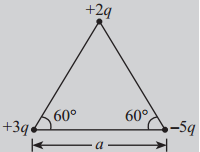
Find the magnitude of dipole moment of the following system.
Electric Charges and Fields – NEET-19554
  1. A $q a \sqrt { 21 }$
  2. B $q a \sqrt { 13 }$
  3. C $q a \sqrt { 19 }$
  4. D Zero
Show answer

Correct answer: C

15
Two charged spheres separated at a distance R exert a force F on each other. If they are immersed in a liquid of dielectric constant 5 then what is the new force between them
  1. A $\frac { \mathrm { F } } { 5 }$
  2. B F
  3. C 5F
  4. D $\frac { \mathrm { F } } { 2 }$
Show answer

Correct answer: A

16
Two charges of +200 μC and -200 μC are placed at the corners B and C of an equilateral triangle ABC of side 0.1 m. The force on a charge of 5 μC placed at A is
  1. A 1800 N
  2. B $1200 \sqrt { 3 } \mathrm {~N}$
  3. C $600 \sqrt { 3 } \mathrm {~N}$
  4. D 900 N
Show answer

Correct answer: D

17
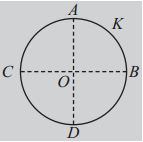
A thin conducting ring of radius R is given a charge +Q. The electric field at the centre O of the ring due to the charge on the part AKB of the ring is E. The electric field at the centre due to the charge on the part ACDB of the ring is:
Electric Charges and Fields – NEET-19617
  1. A 3E along OK
  2. B 3E olong KO
  3. C E along OK
  4. D E along KO
Show answer

Correct answer: C

18
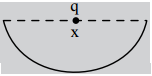
The flux through the hemispherical shell as shown in the figure is
Electric Charges and Fields – NEET-19568
  1. A $\frac { \mathrm { q } } { \varepsilon _ { 0 } }$
  2. B $\frac { \mathrm { q } } { 2 \varepsilon _ { 0 } }$
  3. C 0
  4. D $\frac { 2 q } { \varepsilon _ { 0 } }$
Show answer & explanation

Correct answer: B

Electric Charges and Fields – NEET-19568 For complete sphere, $\phi=\frac{q}{\varepsilon_{0}}$
∴ For hemisphere, $\phi=\frac{q}{2 \varepsilon_{0}}$
Therefore, option (B) is the correct answer.
19
Two charged particles having charge $2 \times 10 ^ { - 8 } \mathrm { C }$ each are joined by an insulating string of length 1 m and the system is kept on a smooth horizontal table, what is the tension in the string?
  1. A $3.6 \times 10 ^ { - 6 } \mathrm {~N}$
  2. B $3.4 \times 10 ^ { - 6 } \mathrm {~N}$
  3. C $4 \times 10 ^ { - 7 } \mathrm {~N}$
  4. D $3 \times 10 ^ { - 4 } \mathrm {~N}$
Show answer

Correct answer: A

20
Three charges -q , +q, and -q are placed at the corners of an equilateral triangle of side 'a'. The resultant electric force on a charge +q placed at the centroid O of the triangle is
  1. A $\frac { 3 q ^ { 2 } } { 4 \pi \varepsilon _ { 0 } a ^ { 2 } }$
  2. B $\frac { q ^ { 2 } } { 4 \pi \varepsilon _ { 0 } a ^ { 2 } }$
  3. C $\frac { q ^ { 2 } } { 2 \pi \varepsilon _ { 0 } a ^ { 2 } }$
  4. D $\frac { 3 q ^ { 2 } } { 2 \pi \varepsilon _ { 0 } a ^ { 2 } }$
Show answer

Correct answer: D

Attempt this as a timed test

Reading answers is not the same as sitting the paper. Attempt it timed and you get your score, per-question timing, and the mistakes tracked for revision.

Start free

More Electric Charges and Fields tests

All Electric Charges and Fields tests →