Electric Charges and Fields — DPP 2

20 NEET questions from Electric Charges and Fields, with answers and explanations. Attempt it as a timed test to get scoring, accuracy breakdown and mistake tracking.

Attempt this test free 20 questions · 30 minutes · +80 marks
1
Electric charge of any system is
  1. A Zero or neutral
  2. B Half integral multiple of the least amount of charge
  3. C Integral multiple of least amount of charge
  4. D One third the least amount of charge
Show answer

Correct answer: C
2
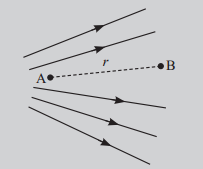
Figure shows the electric lines of force emerging from a charged body. If electric field at A and B are $E _ { A }$ and $E _ { B }$ respectively and distance between A and B is r then
Electric Charges and Fields – NEET-19545
  1. A $E _ { A } > E _ { B }$
  2. B $E _ { A } = E _ { B }$
  3. C $E _ { A } < E _ { B }$
  4. D $E _ { A } = \frac { E _ { B } } { r ^ { 2 } }$
Show answer

Correct answer: A

3
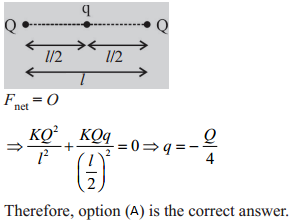
Two equal charges 'Q' are placed at a distance l apart. A third charge 'q' is placed at the midpoint between them such that entire system is in equilibrium. The value of charge q is
  1. A $- \frac { Q } { 4 }$
  2. B $\frac { Q } { 4 }$
  3. C $\frac { Q } { 2 }$
  4. D $- \frac { Q } { 2 }$
Show answer & explanation

Correct answer: A

Electric Charges and Fields – NEET-19560
4
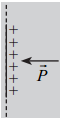
An electric dipole is placed perpendicular to an infinite line of charge at small distance as shown in figure. Identify the correct statement.
Electric Charges and Fields – NEET-19555
  1. A The dipole is attracted towards the line charge
  2. B The dipole is repelled away from the line charge
  3. C The dipole does not experience a force
  4. D The dipole experience a force as well as a torque
Show answer

Correct answer: B

5
Consider a neutral conducting sphere. A positive point charge is placed outside the sphere. The net charge on the sphere is
  1. A Zero
  2. B Negative and distributed uniformly over the surface of the sphere
  3. C Negative and distributed non-uniformly over the surface of the sphere
  4. D Negative and appears only at the point on the sphere closest to the point charge
Show answer & explanation

Correct answer: A

When a positive point charge is placed outside a conducting surface, redistribution of charges takes place on the surface. But the total charge is zero as no charge enters or leaves the surface. Therefore, option (A) is the correct answer.
6
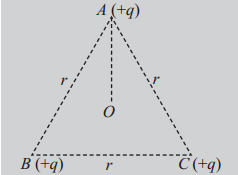
ABC is an equilateral triangle. Charges +q are placed at each corner. The electric intensity at centre O will be
Electric Charges and Fields – NEET-19541
  1. A $\frac { 1 } { 4 \pi \varepsilon _ { 0 } } \frac { q } { r ^ { 2 } }$
  2. B $\frac { 1 } { 4 \pi \varepsilon _ { 0 } } \frac { q } { r }$
  3. C Zero
  4. D $\frac { 1 } { 4 \pi \varepsilon _ { 0 } } \frac { 3 q } { r ^ { 2 } }$
Show answer

Correct answer: C

7
A pendulum bob of mass 40 mg and carrying a charge of $2 \times 10 ^ { - 8 } \mathrm { C }$ is at rest in a horizontal uniform electric field of $2 \times 10 ^ { 7 } \mathrm { Vm } ^ { - 1 }$. Calculate the tension in the thread of the pendulum and the angle it makes with the vertical.
  1. A $\theta = 45 ^ { \circ } , T = \sqrt { 32 } \times 10 ^ { - 1 } N$
  2. B $\theta = 30 ^ { \circ } , T = \sqrt { 32 } \times 10 ^ { - 1 } \mathrm {~N}$
  3. C $\theta = 30 ^ { \circ } , \mathrm { T } = \sqrt { 32 } \times 10 ^ { - 1 } \mathrm {~N}$
  4. D $\theta = 30 ^ { \circ } , T = \sqrt { 8 } \times 10 ^ { - 1 } \mathrm {~N}$
Show answer & explanation

Correct answer: A

Charge of bob, q = 2 × 10$^{–8}$ C
mass of bob, m = 40 mg = 40 × 10$^{–3}$ kg
electric field, E = 2 × 10$^{7}$ Vm$^{–1}$
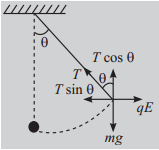
Let, the θ is the angle, made by thread with vertical line.
Free body diagram:
Let T be the tension in the string and θ be the angle it makes with the vertical, Fig.
Electric Charges and Fields – NEET-19567 For equilibrium,
T sin θ = qE ...(i)
T cos θ = mg ...(ii)
On dividing equation (i) by (ii) we get
$\tan \theta=\frac{\mathrm{qE}}{\mathrm{mg}}$
Substituting the values in the above equation, we get
$\tan \theta=\frac{2 \times 10^{-8} \times 2 \times 10^{7}}{40 \times 10^{-3} \times 10}$
tan θ = 1
∴ θ = 45°
by using equation (i),
$\begin{array}{l}\mathrm{T}=\frac{\mathrm{qE}}{\sin \theta}=\frac{2 \times 10^{-8} \times 2 \times 10^{7}}{\sin 45^{\circ}} \\ \mathrm{T}=0.4 \sqrt{2} \mathrm{~N} \\ \therefore \mathrm{~T}=\sqrt{32} \times 10^{-1} \mathrm{~N}\end{array}$
Therefore, option (A) is the correct answer.
8
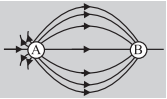
The spatial distribution of the electric field due to two charges (A, B) is as shown in the figure.
Electric Charges and Fields – NEET-19576 Which one of the following statements is correct?
  1. A A is +ve and B -ve and |A| > |B|
  2. B A is -ve and B +ve and |A| = |B|
  3. C Both are +ve but A > B
  4. D Both are -ve but A > B
Show answer & explanation

Correct answer: A

$\bar{E}$ lines are coming out of A and reaching to B this shows that A must be +ve and B should be a-ve charge. Also, more will be the electric lines of forces more will be its magnitude. Therefore, option (A) is the correct answer.
9
A force of 4 N is acting between two charges in air. If the space between them is completely filled with glass $\left( \varepsilon _ { \mathrm { r } } = 8 \right)$, then the new force will be
  1. A 2 N
  2. B 5 N
  3. C 0.2 N
  4. D 0.5 N
Show answer

Correct answer: D

10
One million electrons are added to a glass rod. The total charge on the rod is
  1. A $10 ^ { - 13 } \mathrm { C }$
  2. B $- 1.6 \times 10 ^ { - 13 } \mathrm { C }$
  3. C $+ 1.6 \times 10 ^ { - 12 } \mathrm { C }$
  4. D $10 ^ { - 12 } \mathrm { C }$
Show answer

Correct answer: B

11
Charge Q is placed at each of the two diagonally opposite corners of a square. Also charge q is placed at each of the other two corners. If net force on charge Q is zero, then $\frac { Q } { q }$ is:
  1. A $- 2 \sqrt { 2 }$
  2. B -2
  3. C $- \sqrt { 2 }$
  4. D $\frac { 1 } { \sqrt { 2 } }$
Show answer & explanation

Correct answer: A

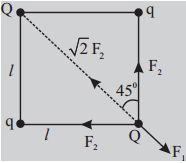
Electric Charges and Fields – NEET-19561 Let F$_{1}$ be the force between Q and Q.
For the net force on Q to be zero, the force between Q and q should be attractive.
Let F$_{2}$ be the force between Q and q.
∴ Net force on Q is zero.
$\begin{array}{l}2 F_{2} \cos 45^{0}=-F_{1} \\ \therefore \sqrt{2} F_{2}=-F_{1} \Rightarrow \sqrt{2} \frac{K Q q}{l^{2}}=-\frac{K Q^{2}}{(\sqrt{2} l)^{2}} \\ \Rightarrow \frac{Q}{q}=-2 \sqrt{2}\end{array}$
Therefore, option (A) is the correct answer.
12
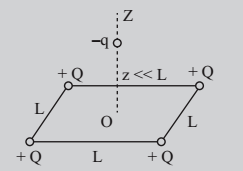
Four point positive charges of same magnitude (Q) are placed at four corners of a rigid square frame as shown in figure. The plane of the frame is perpendicular to z-axis. If a negative point charge is placed at a distance z away from the above frame, the
Electric Charges and Fields – NEET-19563
  1. A -q charge oscillates along the Z-axis
  2. B It moves away from the frame
  3. C It moves slowly towards the frame and stays in the plane of the frame
  4. D It passes through the frame only once
Show answer & explanation

Correct answer: A

Since, the net force on the –ve charge will act downwards due to force of attraction it goes down the frame, till it reaches the plane of frame the charge continues to experience downward force but as it goes down it starts experiencing an upward pull. Similarly, it will always experience an attractive force in the z-axis. Hence, it will oscillate along z-axis.
Therefore, option (A) is the correct answer.
13
Two identical metal spheres possess +60 C and -20 C of charges. They are brought in contact and then separated by 10 cm. The force between them is
  1. A $36 \times 10 ^ { 13 } \mathrm {~N}$
  2. B $36 \times 10 ^ { 14 } \mathrm {~N}$
  3. C $36 \times 10 ^ { 12 } \mathrm {~N}$
  4. D $36 \times 10 ^ { 11 } \mathrm {~N}$
Show answer

Correct answer: A

14
20 μC charge is placed inside a closed surface, then flux linked with the surface is Φ. If 80 μC charge is put inside the surface then change in flux is;
  1. A 4Φ
  2. B 5Φ
  3. C Φ
  4. D 8Φ
Show answer

Correct answer: A

15
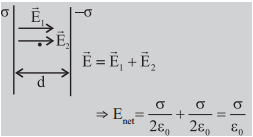
Two infinite plane parallel sheets, separated by a distance d have equal and opposite uniform charge densities σ. Electric field at a point between the sheet is
  1. A $\frac { \sigma } { 2 \varepsilon _ { 0 } }$
  2. B $\frac { \sigma } { \varepsilon _ { 0 } }$
  3. C Zero
  4. D Depends on the location of the point
Show answer & explanation

Correct answer: B

Electric Charges and Fields – NEET-19564 At every point between the plates.
Therefore, option (B) is the correct answer.
16
The distance between the two charges, 25 μC and 36 μC, is 11 cm. At what point on the line joining the two will the intensity be zero?
  1. A At a distance of 5 cm from 25 μC
  2. B At a distance of 5 cm from 36 μC
  3. C At a distance of 10 cm from 25 μC
  4. D At a distance of 11 cm from 36 μC
Show answer

Correct answer: A

17
How many electrons must be removed from a piece of metal to give it a positive charge of $1 \times 10 ^ { - 7 } \mathrm { C }$?
  1. A $6.25 \times 10 ^ { - 11 }$
  2. B $6.25 \times 10 ^ { - 12 }$
  3. C $6.25 \times 10 ^ { 11 }$
  4. D $6.25 \times 10 ^ { 13 }$
Show answer

Correct answer: C

18
A charged oil drop is suspended in a uniform field of $2 \times 10 ^ { 5 } \mathrm {~V} / \mathrm { m }$ so that it neither fall nor rises. The charge on the drop will be (mass of the charge is $9 \times 10 ^ { - 15 } \mathrm {~kg}$)
  1. A $9 \times 10 ^ { - 18 } \mathrm { C }$
  2. B $9 \times 10 ^ { - 19 } \mathrm { C }$
  3. C $4.5 \times 10 ^ { - 20 } \mathrm { C }$
  4. D $4.5 \times 10 ^ { - 19 } \mathrm { C }$
Show answer & explanation

Correct answer: D

At equilibrium, electric force on charged oil drop will balance the weight
$\therefore \quad q E=m g \Rightarrow q=\frac{m g}{E}=\frac{9 \times 10^{-15} \times 10}{2 \times 10^{5}}=4.5 \times 10^{-19} \mathrm{C}$
Therefore, option (D) is the correct answer.
19
The electric charge in uniform motion produces;
  1. A An electric field only
  2. B A magnetic field only
  3. C Both electric and magnetic field
  4. D Neither electric nor magnetic field
Show answer

Correct answer: C

20
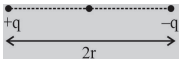
Two charges +q and -q are placed at a distance of 2r as shown in the figure. Electric field at the centre of the line joining 2 charges is
Electric Charges and Fields – NEET-19577
  1. A $\frac { K q } { r ^ { 2 } }$
  2. B $\frac { 4 K q } { r ^ { 2 } }$
  3. C $\frac { 2 K q } { r ^ { 2 } }$
  4. D $\frac { K q } { 2 r ^ { 2 } }$
Show answer & explanation

Correct answer: C

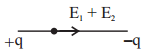
$E_{\mathrm{net}}=E_{1}+E_{2}=2 E=2 \frac{K q}{r^{2}}$
Electric Charges and Fields – NEET-19577 Therefore, option (C) is the correct answer.

Attempt this as a timed test

Reading answers is not the same as sitting the paper. Attempt it timed and you get your score, per-question timing, and the mistakes tracked for revision.

Start free

More Electric Charges and Fields tests

All Electric Charges and Fields tests →