Oscillations — DPP 1

20 NEET questions from Oscillations, with answers and explanations. Attempt it as a timed test to get scoring, accuracy breakdown and mistake tracking.

Attempt this test free 20 questions · 30 minutes · +80 marks
1
S.H.M. has amplitude 'A' and time period T. The maximum velocity will be
  1. A $\frac { 4 \mathrm {~A} } { \mathrm {~T} }$
  2. B $\frac { 2 \mathrm {~A} } { \mathrm {~T} }$
  3. C $2 \pi \sqrt { \frac { A } { T } }$
  4. D $\frac { 2 \pi A } { T }$
Show answer

Correct answer: D
2
The total vibrational energy of a particle in S.H.M. is E. Its kinetic energy at half the amplitude from mean position will be;
  1. A $\frac { E } { 2 }$
  2. B $\frac { E } { 3 }$
  3. C $\frac { E } { 4 }$
  4. D $\frac { 3 E } { 4 }$
Show answer

Correct answer: D

3
If total energy of a particle in S.H.M. is E, then the potential energy of the particle at half the amplitude will be;
  1. A $\frac { E } { 2 }$
  2. B $\frac { E } { 4 }$
  3. C $\frac { 3 E } { 4 }$
  4. D $\frac { E } { 8 }$
Show answer

Correct answer: B

4
Which of the following expressions does not represent simple harmonic motion?
  1. A $x = A \sin ( \omega t + \phi )$
  2. B $x = \mathrm { B } \cos ( \omega t + \phi )$
  3. C $x = A \tan ( \omega t + \phi )$
  4. D $x = \mathrm { A } \sin \omega t \cdot \cos \omega t$
Show answer

Correct answer: C

5
Which one of the following equations of motion represents simple harmonic motion?
  1. A Acceleration $= - k _ { 0 } x + k _ { 1 } x ^ { 2 }$
  2. B Acceleration = -k(x + a)
  3. C Acceleration = k(x + a)
  4. D Acceleration = kx
Show answer

Correct answer: B

6
If a spring has a time period T, and is cut into n equal parts, then the time period of each part will be
  1. A $T \sqrt{n}$
  2. B $\frac{T}{\sqrt{n}}$
  3. C nT
  4. D T
Show answer

Correct answer: B

7
Which of the following functions represents a simple harmonic oscillations?
  1. A $\sin \omega t - \cos \omega t$
  2. B $\sin ^ { 2 } \omega t$
  3. C $\sin \omega t + \sin 2 \omega t$
  4. D $\sin \omega t - \sin 2 \omega t$
Show answer & explanation

Correct answer: A

$\begin{array}{l}y=\sin \omega t-\cos \omega t \\ \begin{array}{l} \frac{d y}{d t}=\omega \cos \omega t+\omega \sin \omega t \\ \begin{aligned} \frac{d^{2} y}{d t^{2}} & =-\omega^{2} \sin \omega t+\omega^{2} \cos \omega t \\ & =-\omega^{2}(\sin \omega t-\cos \omega t) .\end{aligned} \\ a=-\omega^{2} y . \therefore a \propto-y .\end{array}\end{array}$
which is the condition of simple harmonic motion.
Therefore, option (A) is the correct answer.
8
Equation of a particle executing SHM is $\frac { 2 d ^ { 2 } x } { d t ^ { 2 } } + 32 x =$ 0 , then the time period of the body (in second) is
  1. A Zero
  2. B π
  3. C 2π
  4. D $\frac { \pi } { 2 }$
Show answer

Correct answer: D

9
The phase difference between the instantaneous velocity and acceleration of a particle executing simple harmonic motion is:
  1. A $0.5 \pi$
  2. B $\pi$
  3. C $0.707 \pi$
  4. D Zero
Show answer & explanation

Correct answer: A

For particle executing S.H.M,
x = Asinwt
$\begin{aligned} \therefore \mathrm{v} & =\frac{\mathrm{dx}}{\mathrm{dt}}=\mathrm{A} \omega \cos \omega \mathrm{t} \\ & =\mathrm{A} \omega \sin \left(\omega \mathrm{t}+\frac{\pi}{2}\right) \text { and } \\ a= & \frac{\mathrm{dv}}{\mathrm{dt}}=-\mathrm{A} \omega^{2} \sin \omega \mathrm{t}=-\mathrm{A} \omega^{2} \sin (\omega \mathrm{t}+\pi)\end{aligned}$
Phase difference between acceleration and velocity is,
$=(\omega \mathrm{t}+\pi)-\left(\omega \mathrm{t}+\frac{\pi}{2}\right)=\pi-\frac{\pi}{2}=\frac{\pi}{2}=0.5 \pi$.
So option (A) is correct.
10
A piece of wood has dimensions $a \times b \times c$. It is floating in a water of density $\rho _ { w }$ such that the side 'a' is vertical. Relative density of wood is $\rho$. It is now pushed down gently. The time period is;
  1. A $2 \pi \sqrt { \frac { \rho a } { g } }$
  2. B $2 \pi \sqrt { \frac { a b c } { g } }$
  3. C $2 \pi \sqrt { \frac { g } { \rho a } }$
  4. D $2 \pi \sqrt { \frac { b c } { \rho g } }$
Show answer

Correct answer: A

11
The total energy of a particle executing S.H.M. is directly proportional to the square of the following quantity;
  1. A Acceleration
  2. B Amplitude
  3. C Time period
  4. D Mass
Show answer

Correct answer: B

12
The length of a simple pendulum is $\frac { 39.2 } { \pi ^ { 2 } } \mathrm {~m}$. If $g = 9.8 \mathrm {~m} / \mathrm { sec } ^ { 2 }$, the value of time period is;
  1. A 4 s
  2. B 8 s
  3. C 2 s
  4. D 3 s
Show answer

Correct answer: A

13
If the displacement of a particle executing SHM is given by y = 0.3 sin (220t + 0.64) in metre, then the frequency and maximum velocity of the particle is
  1. A 35 Hz , 66 m/s
  2. B 45 Hz , 66 m/s
  3. C 58 Hz , 113 m/s
  4. D 35 Hz , 132 m/s
Show answer

Correct answer: A

14
The total energy of a vibrating particle in S.H.M. is $E$. If its amplitude and time period are doubled, its total energy will be;
  1. A 16E
  2. B 8E
  3. C 4E
  4. D E
Show answer

Correct answer: D

15
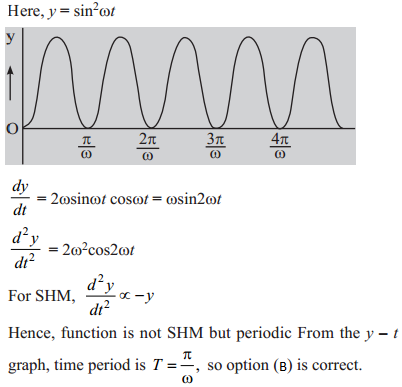
The function $\sin ^ { 2 } ( \omega \mathrm { t } )$ represents:
  1. A A periodic, but not simple harmonic motion with a period $2 \pi / \omega$
  2. B A periodic, but not simple harmonic motion with period $\pi / \omega$
  3. C A simple harmonic motion with a period $2 \pi / \omega$
  4. D A simple harmonic motion with a period $\pi / \omega$
Show answer & explanation

Correct answer: B

Oscillations – NEET-18414
16
A child swinging on a swing in standing position, changed his position from standing to sitting then the time period of the swing will be;
  1. A decrease
  2. B increase
  3. C remain same
  4. D first increase then decrease
Show answer

Correct answer: B

17
A particle is executing S.H.M. If its amplitude is 2 m and periodic time 2 seconds, then the maximum velocity of the particle will be
  1. A π m/s
  2. B $\sqrt { 2 \pi } \mathrm {~m} / \mathrm { s }$
  3. C 2π m/s
  4. D 4π m/s
Show answer

Correct answer: C

18
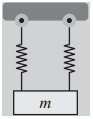
A mass m is suspended separately by two diffrent springs of spring constant K$_{1}$ and K$_{2}$ gives the time period t$_{1}$ and t$_{2}$ respectively. If same mass m is connected by both springs as shown in fiure then the time period t is given by the relation
Oscillations – NEET-18336
  1. A $t=t_{1}+t_{2}$
  2. B $t=\frac{t_{1} \cdot t_{2}}{t_{1}+t_{2}}$
  3. C $t^{2}=t_{1}^{2}+t_{2}^{2}$
  4. D $t^{-2}=t_{1}^{-2}+t_{2}^{-2}$
Show answer

Correct answer: D

19
What is the phase difference between two simple harmonic motions represented by $\mathrm { X } _ { 1 } = \mathrm { A } \sin \left( \omega \mathrm { t } + \frac { \pi } { 6 } \right)$ and $\mathrm { X } _ { 2 } = \mathrm { A } \cos \omega \mathrm { t }$ ?
  1. A $\frac { \pi } { 6 }$
  2. B $\frac { \pi } { 3 }$
  3. C $\frac { \pi } { 2 }$
  4. D $\frac { 2 \pi } { 3 }$
Show answer

Correct answer: B

20
The displacement of a particle moving in S.H.M. at any instant is given by $y = a \sin \omega t$. The acceleration after time $t = \frac { T } { 4 }$ is (where T is the time period)
  1. A $a \omega$
  2. B $- a \omega$
  3. C $a \omega ^ { 2 }$
  4. D $- a \omega ^ { 2 }$
Show answer

Correct answer: D

Attempt this as a timed test

Reading answers is not the same as sitting the paper. Attempt it timed and you get your score, per-question timing, and the mistakes tracked for revision.

Start free

More Oscillations tests

All Oscillations tests →