Oscillations — DPP 2

20 NEET questions from Oscillations, with answers and explanations. Attempt it as a timed test to get scoring, accuracy breakdown and mistake tracking.

Attempt this test free 20 questions · 30 minutes · +80 marks
1
If particle is executing simple harmonic motion with time period T, then the time period of its total mechanical energy is
  1. A Zero
  2. B $\frac { T } { 2 }$
  3. C 2T
  4. D Infinite
Show answer

Correct answer: D
2
The total energy of a particle executing simple harmonic motion is:( x is displacement from mean position)
  1. A ∝ x
  2. B ∝ x$^{2}$
  3. C Independent of x
  4. D $\propto x^{1 / 2}$
Show answer & explanation

Correct answer: C

Independent of x. As energy always remain constant at each point of x. Only the object oscillate and energy transform from one form to another.
Therefore, option (C) is the correct answer.
3
Which of the following is NOT a characteristic of oscillatory motion?
  1. A It is repetitive
  2. B It has a fixed frequency
  3. C It moves only in one direction
  4. D It has a definite period
Show answer

Correct answer: C

4
Two springs of constant k1 and k2 are joined in series. The effective spring constant of the combination is given by
  1. A $\sqrt{k_{1} k_{2}}$
  2. B $\frac{\left(k_{1}+k_{2}\right)}{2}$
  3. C $k_{1}+k_{2}$
  4. D $\frac{k_{1} k_{2}}{\left(k_{1}+k_{2}\right)}$
Show answer

Correct answer: D

5
A spring block system in horizontal oscillation has a time period T. Now the spring is cut into four equal parts, and the block is re-connected with one of the parts. The new time period of vertical oscillation will be
  1. A $\frac { T } { \sqrt { 2 } }$
  2. B 2T
  3. C $\frac { T } { 2 }$
  4. D $\frac { T } { 2 \sqrt { 2 } }$
Show answer

Correct answer: C

6
If a particle is executing simple harmonic motion, then acceleration of particle
  1. A is uniform
  2. B Varies linearly with time
  3. C Is non uniform
  4. D Both (B) & (C)
Show answer

Correct answer: C

7
The length of a simple pendulum is increased four times of its initial value, its time period with respect to its previous value will;
  1. A become twice
  2. B remain same
  3. C become halved
  4. D become $\sqrt { 2 }$ times
Show answer

Correct answer: A

8
A block of mass m is suspended separately by two different springs have time period t$_{1}$ and t$_{2}$. If same mass is connected to a parallel combination of both springs, then its time period is given by
  1. A $\frac { t _ { 1 } t _ { 2 } } { t _ { 1 } + t _ { 2 } }$
  2. B $\frac { t _ { 1 } t _ { 2 } } { \sqrt { t _ { 1 } ^ { 2 } + t _ { 2 } ^ { 2 } } }$
  3. C $\sqrt { \frac { t _ { 1 } t _ { 2 } } { t _ { 1 } + t _ { 2 } } }$
  4. D $t _ { 1 } + t _ { 2 }$
Show answer

Correct answer: B

9
What is the phase difference between acceleration and velocity of a particle executing simple harmonic motion?
  1. A Zero
  2. B $\frac { \pi } { 2 }$
  3. C π
  4. D 2π
Show answer

Correct answer: B

10
The shape of graph plotted between velocity and position of a particle executing simple harmonic motion is
  1. A A straight line
  2. B An ellipse
  3. C A parabola
  4. D A hyperbola
Show answer

Correct answer: B

11
Assertion (A): In SHM the change in velocity is not uniform.
Reason (R): In SHM the acceleration of body varies linearly with its displacement.
  1. A Both Assertion (A) and Reason (R) are True and the Reason (R) is a correct explanation of the Assertion (A).
  2. B Both Assertion (A) and Reason Reason (R) are True but Reason (R) is not a correct explanation of the Assertion (A).
  3. C Assertion (A) is True but the Reason (R) is False.
  4. D Assertion (A) and Reason (R) are False
Show answer

Correct answer: A

12
A 100 g mass stretches a particular spring by 9.8 cm, when suspended vertically from it. How large a mass must be attached to the spring if the period of vibration is to be 6.28 s?
  1. A 1000 g
  2. B 105 g
  3. C 107 g
  4. D 10$^{4}$ g
Show answer

Correct answer: D

13
Assertion (A): Acceleration is proportional to the displacement; this condition is not suffient for motion in simple harmonic.
Reason (R): In simple harmonic motion, direction of displacement is also considered.
  1. A Both Assertion (A) and Reason (R) are True and the Reason (R) is a correct explanation of the Assertion (A).
  2. B Both Assertion (A) and Reason Reason (R) are True but Reason (R) is not a correct explanation of the Assertion (A).
  3. C Assertion (A) is True but the Reason (R) is False.
  4. D Assertion (A) and Reason (R) are False
Show answer

Correct answer: A

14
A child on a swing experiences oscillatory motion. What is the highest point of oscillation called?
  1. A Mean position
  2. B Extreme position
  3. C Minimum displacement
  4. D Can't predict
Show answer

Correct answer: B

15
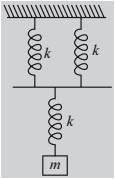
A block of mass m hangs from three springs having the same spring constant k. If the mass is slightly displaced downwards, the time period of oscillation will be
Oscillations – NEET-18483
  1. A $2 \pi \sqrt { \frac { 2 m } { 3 k } }$
  2. B $2 \pi \sqrt { \frac { m } { 2 k } }$
  3. C $2 \pi \sqrt { \frac { 3 m } { 2 k } }$
  4. D $2 \pi \sqrt { \frac { m } { k } }$
Show answer

Correct answer: C

16
How is the time period of simple pendulum vary with its amplitude?
  1. A $T \propto a$
  2. B $T \propto a ^ { 2 }$
  3. C Does not depend on its amplitude
  4. D $T \propto \sqrt { a }$
Show answer & explanation

Correct answer: C

$\mathrm{T}=2 \pi \sqrt{\frac{l}{\mathrm{~g}}}$
∴ It does not depend on amplitude.
Therefore, option (3) is the correct answer.
17
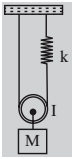
The time period of mass M when displaced from its equilibrium position and then released for the system as shown in figure is:
Oscillations – NEET-18423
  1. A $2 \pi \sqrt { \frac { M } { k } }$
  2. B $2 \pi \sqrt { \frac { M } { 2 k } }$
  3. C $2 \pi \sqrt { \frac { M } { 4 k } }$
  4. D $2 \pi \sqrt { \frac { 2 M } { k } }$
Show answer & explanation

Correct answer: C

When mass M is suspended from the given system as shown in figure, let l be the length through which mass M moves down before it comes to rest. In this situation, both the spring and string will be stretched by length l. Since string is inextensible, so spring is stretched by length 2l. The tension along the string and spring is the same.
In equilibrium,
Mg = 2(k2l)
If mass M is pulled down through small distance x, then
F = Mg – 2k(2l + 2x) = – 4kx .....(i)
F ∝ x and –ve sign shows that it is directed towards mean position.
Hence, the mass executes simple harmonic motion.
For S.H.M, F = –k$_{eq}$ x .....(ii)
Comparing (i) and (ii), we get k$_{eq}$ = 4k
∴ Time period, T = $2 \pi \sqrt{\frac{\mathrm{M}}{4 \mathrm{k}}}$
Therefore, option (C) is the correct answer.
18
The mass and diameter of a planet are twice those of earth. The period of oscillation of pendulum on this planet will be: (if it is a seconds pendulum on earth)
  1. A $1 / \sqrt { 2 } s$
  2. B $2 \sqrt { 2 } \mathrm {~s}$
  3. C 2 s
  4. D $\frac{1}{2}$ s
Show answer & explanation

Correct answer: B

Change on gravity
$\begin{array}{l}g_{e}=\frac{G M}{R^{2}}, g_{p}=\frac{G \times 2 M}{(2 R)^{2}}=\frac{G M}{2 R^{2}}=\frac{g_{e}}{2} \\ \therefore T^{\prime}=2 \pi \sqrt{\frac{l}{g_{P}}}=2 \pi \sqrt{\frac{\ell}{g / 2}} \\ \mathrm{~T}^{\prime}=2 \pi \sqrt{\frac{\ell}{\mathrm{~g}} \times 2}=\sqrt{2} \times \mathrm{T}=\sqrt{2} \times 2 \text { second }\end{array}$
Therefore, option (B) is the correct answer.
19
Identify the correct definition
  1. A If after every certain interval of time, particle repeats its motion then motion is called periodic motion
  2. B To and fro motion of a particle over the same path is called oscillatory motion
  3. C Oscillatory motion described in terms of single sine and cosine functions is called simple harmonic motion
  4. D All of these
Show answer

Correct answer: D

20
What is the time taken to complete one full cycle of oscillation called?
  1. A Frequency
  2. B Amplitude
  3. C Time period
  4. D Wavelength
Show answer

Correct answer: C

Attempt this as a timed test

Reading answers is not the same as sitting the paper. Attempt it timed and you get your score, per-question timing, and the mistakes tracked for revision.

Start free

More Oscillations tests

All Oscillations tests →