Oscillations — DPP 3

20 NEET questions from Oscillations, with answers and explanations. Attempt it as a timed test to get scoring, accuracy breakdown and mistake tracking.

Attempt this test free 20 questions · 30 minutes · +80 marks
1
What type of motion does a mass-spring system exhibit when it is displaced and released?
  1. A Linear motion
  2. B Circular motion
  3. C Simple Harmonic Motion
  4. D Rotational motion
Show answer

Correct answer: C
2
The displacement of a particle executing SHM at any instant t is $x = 0.01 \sin 100 \pi ( t + 0.05 )$, then its time period will be
  1. A 0.2 sec
  2. B 0.1 sec
  3. C 0.06 sec
  4. D 0.02 sec
Show answer

Correct answer: D

3
A particle starts its SHM from mean position at t = 0. If its time period is T and amplitude A. The distance travelled by the particle in the time from t = 0 to $t = \frac { 5 T } { 4 }$ is
  1. A A
  2. B 3A
  3. C 4A
  4. D 5A
Show answer

Correct answer: D

4
The maximum displacement from the mean position in SHM is called:
  1. A Frequency
  2. B Amplitude
  3. C Period
  4. D Phase
Show answer

Correct answer: B

5
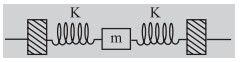
Two identical springs of spring constant k are attached to a block of mass m and to fixed supports as shown in the figure. The time period of oscillation is:
Oscillations – NEET-18422
  1. A $2 \pi \sqrt { \frac { \mathrm {~m} } { \mathrm { k } } }$
  2. B $2 \pi \sqrt { \frac { m } { 2 k } }$
  3. C $2 \pi \sqrt { \frac { 2 \mathrm {~m} } { \mathrm { k } } }$
  4. D $\pi \sqrt { \frac { \mathrm { m } } { 2 \mathrm { k } } }$
Show answer & explanation

Correct answer: B

Since the springs are attached in parallel
$\begin{array}{l}\therefore k_{e f f}=k_{1}+k_{2}=2 k \\ \therefore T=2 \pi \sqrt{\frac{m}{k_{e f f}}}=2 \pi \sqrt{\frac{m}{2 k}}\end{array}$
Therefore, option (B) is the correct answer.
6
For a body in S.H.M. the velocity is given by the relation $V = \sqrt { 144 - 16 x ^ { 2 } } \mathrm {~ms} ^ { - 1 }$. The maximum acceleration is
  1. A $12 \mathrm {~m} / \mathrm { s } ^ { 2 }$
  2. B $16 \mathrm {~m} / \mathrm { s } ^ { 2 }$
  3. C $36 \mathrm {~m} / \mathrm { s } ^ { 2 }$
  4. D $48 \mathrm {~m} / \mathrm { s } ^ { 2 }$
Show answer

Correct answer: D

7
Assertion (A): When soldier cross a bridge, they are asked to break steps.
Reason (R): If they do not break steps, then they will apply large force on bridge simultaneously.
  1. A Both Assertion (A) and Reason (R) are True and the Reason (R) is a correct explanation of the Assertion (A).
  2. B Both Assertion (A) and Reason Reason (R) are True but Reason (R) is not a correct explanation of the Assertion (A).
  3. C Assertion (A) is True but the Reason (R) is False
  4. D Assertion (A) and Reason (R) are False
Show answer

Correct answer: C

8
The equation for the displacement of a particle executing SHM is y = 5 sin 2πt cm. Then the velocity at 3 cm from the mean position is
  1. A $2 \pi \mathrm {~cm} / \mathrm { s }$
  2. B $3 \pi \mathrm {~cm} / \mathrm { s }$
  3. C $4 \pi \mathrm {~cm} / \mathrm { s }$
  4. D $8 \pi \mathrm {~cm} / \mathrm { s }$
Show answer

Correct answer: D

9
The amplitude of a particle executing SHM is 4 cm. At the mean position, the speed of the particle is 16 cm/s. The distance of the particle from the mean position at which the speed of the particle becomes 8√3 cm/sec will be
  1. A $2 \sqrt { 3 }$
  2. B $\sqrt { 3 }$
  3. C 1
  4. D 2
Show answer

Correct answer: D

10
A particle executing a simple harmonic motion has a period of 6 sec. The time taken by the particle to move from the mean position to half the amplitude, starting from the mean position, is
  1. A $\frac { 3 } { 2 } \mathrm {~s}$
  2. B $\frac { 1 } { 2 } \mathrm {~s}$
  3. C $\frac { 3 } { 4 } \mathrm {~s}$
  4. D $\frac { 1 } { 4 } \mathrm {~s}$
Show answer

Correct answer: B

11
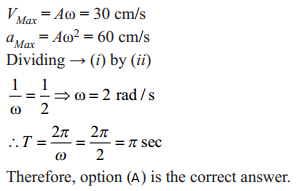
A particle executing S.H.M has a maximum speed of $30 \mathrm {~cm} \mathrm {~s} ^ { - 1 }$ and a maximum acceleration of $60 \mathrm {~cm} \mathrm {~s} ^ { - 2 }$. The time period of oscillation (in seconds) is:
  1. A $\pi$
  2. B $\frac { \pi } { 2 }$
  3. C $\frac { \pi } { 4 }$
  4. D $2 \pi$
Show answer & explanation

Correct answer: A

Oscillations – NEET-18415
12
A body of mass 1/4 kg is in S.H.M. and its displacement is given by the relation $\mathrm { y } = 0.05 \operatorname { Sin } \left( 20 \mathrm { t } + \frac { \pi } { 2 } \right) \mathrm { m }$. If t is in seconds, the maximum force acting on the particle is
  1. A 5 N
  2. B 2.5 N
  3. C 10 N
  4. D 0.25 N
Show answer

Correct answer: A

13
If equation of displacement of a particle is $y = A \sin \pi t + B \cos \pi t$ then motion of particle is
  1. A Simple harmonic motion
  2. B Linear motion
  3. C Uniform circular motion
  4. D Uniform elliptical motion
Show answer

Correct answer: A

14
Two equation of two S.H.M. are $x = a \sin ( \omega t - \alpha )$ and $y = b \cos ( \omega t - \alpha )$. The phase difference between the two is:
  1. A $0 ^ { \circ }$
  2. B $\alpha ^ { \circ }$
  3. C $90 ^ { \circ }$
  4. D $180 ^ { \circ }$
Show answer

Correct answer: C

15
A particle is executing simple harmonic motion with an amplitude A and time period T. The displacement of the particle after 2T period from its initial position is
  1. A A
  2. B 4A
  3. C 8A
  4. D Zero
Show answer

Correct answer: D

16
The value of total mechanical energy of a particle in S.H.M. is;
  1. A always constant
  2. B varies with time
  3. C $\frac { 1 } { 2 } k A ^ { 2 } \cos ^ { 2 } ( \omega t + \phi )$
  4. D $\frac { 1 } { 2 } m A ^ { 2 } \cos ^ { 2 } ( \omega t + \phi )$
Show answer

Correct answer: A

17
The equation of simple harmonic motion may not be expressed as (each term has its usual meaning)
  1. A $x = A \sin ( \omega t + \phi )$
  2. B $x=A \cos (\omega t-\phi)$
  3. C $x=\mathrm{a} \sin \omega t+b \cos \omega t$
  4. D $x=A \sin (\omega t+\phi)+B \sin (2 \omega t+\phi)$
Show answer

Correct answer: D

18
The equation of S.H.M. is $y = a \sin ( 2 \pi n t + a )$, then its phase at time t is
  1. A $2 \pi n t$
  2. B $\alpha$
  3. C $2 \pi n t + \alpha$
  4. D $2 \pi t$
Show answer

Correct answer: C

19
The equation of S.H.M. is $y = a \sin ( 2 \pi n t + \alpha )$, then its phase at time t is
  1. A 2πnt
  2. B α
  3. C 2πnt + α
  4. D 2π
Show answer

Correct answer: C

20
A body executing S.H.M. has a maximum velocity of $1 \mathrm {~ms} ^ { - 1 }$ and a maximum acceleration of $4 \mathrm {~ms} ^ { - 1 }$. Its amplitude in metres is
  1. A 1
  2. B 0.75
  3. C 0.5
  4. D 0.25
Show answer

Correct answer: D

Attempt this as a timed test

Reading answers is not the same as sitting the paper. Attempt it timed and you get your score, per-question timing, and the mistakes tracked for revision.

Start free

More Oscillations tests

All Oscillations tests →