Wave Optics — DPP 1

20 NEET questions from Wave Optics, with answers and explanations. Attempt it as a timed test to get scoring, accuracy breakdown and mistake tracking.

Attempt this test free 20 questions · 30 minutes · +80 marks
1
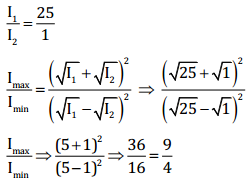
Ratio of intensity of two waves is 25 : 1. If interference occurs, then ratio of maximum and minimum intensity should be :
  1. A 25 : 1
  2. B 5 : 1
  3. C 9 : 4
  4. D 4 : 9
Show answer & explanation

Correct answer: C
Wave Optics – NEET-21564
2
If the intensity of the waves observed by two coherent sources is I. Then the intensity of resultant wave in constructive interference will be :-
  1. A 2 I
  2. B 4 I
  3. C I
  4. D None of the above
Show answer & explanation

Correct answer: B

Constructive interference
$I_{\max }=\left(\sqrt{I_{1}}+\sqrt{I_{2}}\right)^{2} \Rightarrow(\sqrt{I}+\sqrt{I})^{2} \Rightarrow 4 I$
3
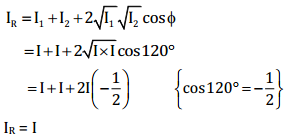
If intensity of each of the two waves is I and they are having phase difference of $120 ^ { 0 }$, when the waves are superimposed, then the resultant intensity will be:
  1. A I
  2. B 2 I
  3. C I/2
  4. D 4 I
Show answer & explanation

Correct answer: A

Wave Optics – NEET-21563
4
Wave nature of light is verified by-
  1. A Interference
  2. B Photo electric effect
  3. C Reflection
  4. D Refraction
Show answer & explanation

Correct answer: A

Wave nature of light is verified by interference.
5
The intensity of two waves is 2 and 3 unit, then average intensity of light in the overlapping region will have the value:
  1. A 2.5
  2. B 6
  3. C 5
  4. D 13
Show answer & explanation

Correct answer: C

$I_{A V}=I_{1}+I_{2}=2+3=5$
6
The light waves from two independent monochromatic light sources are given by $\mathrm{y}_{1}=2 \sin (\omega \mathrm{t}-\mathrm{kx})$ and $\mathrm{y}_{2}=3 \cos (\omega \mathrm{t}-\mathrm{kx})$; then the following statement is correct
  1. A Both the waves are coherent
  2. B Both the waves are incoherent
  3. C Both the waves have different time periods
  4. D None of the above
Show answer & explanation

Correct answer: B

Two independent light source are incoherent.
7
The resultant amplitude in interference with two coherent sources depends upon:
  1. A only amplitude
  2. B only phase difference
  3. C on both the above
  4. D none of the above
Show answer & explanation

Correct answer: C

$A_{\mathrm{Res}}=\sqrt{\mathrm{A}_{1}^{2}+\mathrm{A}_{2}^{2}+2 \mathrm{~A}_{1} \mathrm{~A}_{2} \cos (\Delta \phi)}$
8
The phenomenon of interference is shown by :
  1. A Longitudinal mechanical waves only
  2. B Transverse mechanical waves only
  3. C Electromagnetic waves only
  4. D All the above type of waves
Show answer & explanation

Correct answer: D

Interference is shown by all types of wave.
9
For distinct interference pattern to be observed, necessary condition is that ratio of intensity of light emission by both the sources should be :
  1. A 2 : 1
  2. B 1 : 2
  3. C 1 : 1
  4. D 1 : 4
Show answer & explanation

Correct answer: C

For distinct interference pattern to be observed
$\begin{array}{l}\frac{\mathrm{I}_{1}}{\mathrm{I}_{2}}=1 \\ \therefore \mathrm{I}_{\max }=4 \mathrm{I} \& \mathrm{I}_{\min }=0\end{array}$
10
Amplitude of waves observed by two light sources of same wave length are a and 2a and have a phase difference of π between them. Then minimum intensity of light will be proportional to :
  1. A 0
  2. B $5 a ^ { 2 }$
  3. C $a ^ { 2 }$
  4. D $9 a ^ { 2 }$
Show answer & explanation

Correct answer: C

$I_{\min } \propto\left(a_{1}-a_{2}\right)^{2} \Rightarrow(a-2 a)^{2} \Rightarrow a^{2}$
11
According to huygen's theory of secondary wavelets, following can be explained -
  1. A Propagation of light in medium
  2. B Reflection of light
  3. C Refraction of light
  4. D All of the above
Show answer & explanation

Correct answer: D

Huygen's theory explained propagation of light in medium, reflection of light, refraction of light.
12
The energy in the phenomenon of interference:
  1. A is conserved, gets redistributed
  2. B is equal at every point
  3. C is destroyed in regions of dark fringes
  4. D is created at the place of bright fringes
Show answer & explanation

Correct answer: A

Energy in the phenomenon of interference is conserved, only it gets redistributed.
13
For the sustained interference of light, the necessary condition is that the two sources should:
  1. A Have constant phase difference
  2. B Be narrow
  3. C Be close to each other
  4. D Of same amplitude
Show answer & explanation

Correct answer: A

For sustained interference, the necessary condition is that two sources should have a constant phase difference.
14
The main drawback of huygen's theory was-
  1. A Failure in explanation of rectilinear propagation of light
  2. B Failure of explain the spectrum of white light
  3. C Failure to explain the formation of newton's rings
  4. D A failure of experimental verification of ether medium
Show answer & explanation

Correct answer: D

Huygen's theory not discussed about Newton's ring but his assumption of ether medium is not experimentally verified (failure of experimental verification)
15
Huygen's theory of secondary waves can be used to find-
  1. A Velocity of light
  2. B The wavelength of light
  3. C Wave front geometrically
  4. D Magnifying power of microscope
Show answer & explanation

Correct answer: C

Huygen's theory of secondary waves can be used to find wavefront geometrically.
16
Coherent sources can be obtained :
  1. A only by division of wave front
  2. B only by division of amplitude
  3. C both by division of amplitude and wave front
  4. D none of the above
Show answer & explanation

Correct answer: C

Coherent sources can be obtained by both division of wavefront & division of Amplitude.
17
In an interference of light derived from two slit apertures, if at some point on the screen, yellow light has a path difference of $\frac { 3 \lambda } { 2 }$, then the fringe at that point will be :
  1. A yellow in colour
  2. B white in colour
  3. C dark
  4. D bright
Show answer & explanation

Correct answer: C

$\Delta x=\frac{3 \lambda}{2}$ is the condition of destructive interference
∴ dark fringe is formed.
18
The phase difference corresponding to path difference of x is:
  1. A $\frac { 2 \pi x } { \lambda }$
  2. B $\frac { 2 \pi \lambda } { x }$
  3. C $\frac { \pi x } { \lambda }$
  4. D $\frac { \pi \lambda } { x }$
Show answer & explanation

Correct answer: A

$\begin{array}{ll}\frac{\Delta \phi}{2 \pi}=\frac{\Delta x}{\lambda} & \{\Delta x=x\} \\ \Delta \phi=\frac{2 \pi x}{\lambda} & \end{array}$
19
The coherent source of light produces constructive interference when phase difference between them is :
  1. A $\pi$
  2. B $\frac { 1 } { 2 } \pi$
  3. C $\frac { 3 } { 2 } \pi$
  4. D $2 \pi$
Show answer & explanation

Correct answer: D

For constructive interference
$\begin{array}{l}\Delta \mathrm{x}=\mathrm{n} \lambda \\ \Delta \phi=2 \mathrm{n} \pi\end{array}$
20
Phenomenon of interference is not observed by two sodium lamps of same power. It is because both waves have :
  1. A not constant phase difference
  2. B zero phase difference
  3. C different intensity
  4. D different frequencies
Show answer & explanation

Correct answer: A

Two independent lamps can never be coherent.
∴ phase difference is not constant.

Attempt this as a timed test

Reading answers is not the same as sitting the paper. Attempt it timed and you get your score, per-question timing, and the mistakes tracked for revision.

Start free

More Wave Optics tests

All Wave Optics tests →