Wave Optics — DPP 2

20 NEET questions from Wave Optics, with answers and explanations. Attempt it as a timed test to get scoring, accuracy breakdown and mistake tracking.

Attempt this test free 20 questions · 30 minutes · +80 marks
1
Due to effect of interference, floating oil layer in water is visible coloured, due to observation of this event the thickness of oil layer should be:
  1. A 10 nm
  2. B 0.1 μm
  3. C 1 mm
  4. D 10 mm
Show answer & explanation

Correct answer: B

Thickness of oil layer ≈ 0.1 µm
2
Which of the following statement is true, in Young's experiment, separation between the slits is gradually increased :
  1. A fringe width increases and fringes disappear
  2. B fringe width decreases and fringes disappear
  3. C fringes become blurred
  4. D fringe width remains constant and fringes are more bright
Show answer & explanation

Correct answer: B

$\beta=\frac{\lambda \mathrm{D}}{\mathrm{d}}$, if $\mathrm{d} \uparrow \Rightarrow \beta \downarrow$
3
Huygen's principle is applicable to -
  1. A Only light waves
  2. B Only sound waves
  3. C Only mechanical waves
  4. D For all the above waves
Show answer & explanation

Correct answer: D

Huygen's principle is applicable to all type of waves.
4
Two coherent light beams of intensity I and 4 I are superposed. The maximum and minimum possible intensities in the resulting beam are :
  1. A 5 I and 3 I
  2. B 5 I and I
  3. C 9I and 3I
  4. D 9I and I
Show answer & explanation

Correct answer: D

$\begin{array}{l}I_{\max }=\left(\sqrt{I_{1}}+\sqrt{I_{2}}\right)^{2}=(\sqrt{I}+\sqrt{4 I})^{2} \\ \Rightarrow \quad(\sqrt{I}+2 \sqrt{I})^{2}=9 I \\ I_{\min }=(\sqrt{I}-\sqrt{4 I})^{2} \Rightarrow(\sqrt{I}-2 \sqrt{I})^{2}=I\end{array}$
5
In Young's double slit experiment, one of the slits is so painted that intensity of light emitted from it is half of that of the light emitted from other slit. Then:
  1. A fringe system will disappear
  2. B bright fringes will become brighter and dark fringes will be darker
  3. C both bright and dark fringes will become darker
  4. D dark fringes will become less dark and bright fringes will become less bright.
Show answer & explanation

Correct answer: D

If the amplitude of interferring waves are unequal then intensity is also not equal and fringe visibility is not 100%
∴ contrast in the fringes decreases and dark fringe will become less dark and bright fringe will become less bright.
6
Which of the following phenomenon can not be explained by the Huygen's theory -
  1. A Refraction
  2. B Reflection
  3. C Diffraction
  4. D Polarization
Show answer & explanation

Correct answer: D

Polarization is not explained by Huygen's wave theory.
7
Light has a wave nature, because-
  1. A The light travel in a straight line
  2. B Light exhibits phenomenon of reflection and refraction
  3. C Light exhibits phenomenon of interference
  4. D Light exhibits phenomenon of photo electric effect
Show answer & explanation

Correct answer: C

Reflection & refraction both are explained by Newton's & Huygen's theory but interference explained the wave nature of light.
8
In Young's double slit experiment, bright fringes are of :
  1. A equal widths and unequal intensities
  2. B unequal widths and equal intensities
  3. C equal widths and equal intensities
  4. D unequal widths and unequal intensities
Show answer

Correct answer: C

9
Young's experiment proves that which of the following fact :
  1. A light is made up of particles
  2. B light is made up of waves
  3. C light is made up of neither waves nor particles
  4. D fringe width doesn't depend upon the spacing between slits.
Show answer & explanation

Correct answer: B

Y.D.S.E. proves that light is made up of waves.
10
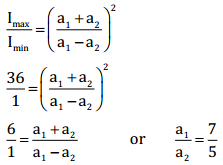
If an interference pattern have maximum and minimum intensities in 36 : 1 ratio then what will be the ratio of amplitudes:
  1. A 5 : 7
  2. B 7 : 4
  3. C 4 : 7
  4. D 7 : 5
Show answer & explanation

Correct answer: D

Wave Optics – NEET-21604
11
Two coherent sources of intensities $\mathrm { I } _ { 1 }$ and $\mathrm { I } _ { 2 }$ produce an interference pattern. The maximum intensity in the interference pattern will be:
  1. A $I _ { 1 } + I _ { 2 }$
  2. B $I _ { 1 } ^ { 2 } + I _ { 2 } ^ { 2 }$
  3. C $\left( I _ { 1 } + I _ { 2 } \right) ^ { 2 }$
  4. D $\left( \sqrt { I _ { 1 } } + \sqrt { I _ { 2 } } \right) ^ { 2 }$
Show answer & explanation

Correct answer: D

$I_{\max }=\left(\sqrt{I_{1}}+\sqrt{I_{2}}\right)^{2}$
12
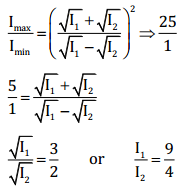
Two coherent sources of different intensities send waves which interfere. If the ratio of maximum and minimum intensity in the interference pattern is 25 then find ratio of intensities of sources :
  1. A 25 : 1
  2. B 5 : 1
  3. C 9 : 4
  4. D 25 : 16
Show answer & explanation

Correct answer: C

Wave Optics – NEET-21602
13
If intensity of each wave in the observed interference pattern in Young's double slit experiment is $\mathrm { I } _ { 0 }$. then for some point P where the phase difference is $\phi$, intensity I will be :
  1. A $I = I _ { 0 } \cos \phi$
  2. B $I = I _ { 0 } \cos ^ { 2 } \phi$
  3. C $I = I _ { 0 } ( 1 + \cos \phi )$
  4. D $\mathrm { I } = 2 \mathrm { I } _ { 0 } ( 1 + \cos \phi )$
Show answer & explanation

Correct answer: D

$\begin{array}{l}\mathrm{I}=\mathrm{I}_{1}+\mathrm{I}_{2}+2 \sqrt{\mathrm{I}_{1} \mathrm{I}_{2}} \cos \phi \\ \mathrm{I}_{\mathrm{R}}=\mathrm{I}_{0}+\mathrm{I}_{0}+2 \sqrt{\mathrm{I}_{0} \mathrm{I}_{0}} \cos \phi \\ \mathrm{I}_{\mathrm{R}}=2 \mathrm{I}_{0}(1+\cos \phi)\end{array}$
14
The resultant amplitude of a vibrating particle by the superposition of the two waves $\mathrm { y } _ { 1 } = \operatorname { asin } \left( \omega \mathrm { t } + \frac { \pi } { 3 } \right)$ and $\mathrm { y } _ { 2 } = \mathrm { a } \sin \omega \mathrm { t }$ is :-
  1. A a
  2. B $\sqrt { 2 }$ a
  3. C 2a
  4. D $\sqrt { 3 } \mathrm { a }$
Show answer & explanation

Correct answer: D

$\begin{aligned} A & =\sqrt{a_{1}^{2}+a_{2}^{2}+2 a_{1} a_{2} \cos \phi} \\ & =\sqrt{a^{2}+a^{2}+2 a^{2} \cos \frac{\pi}{3}} \Rightarrow a \sqrt{3}\end{aligned}$
15
Soap bubble appears coloured due to the phenomenon of :-
  1. A Total internal reflection
  2. B Interference by division of amplitude
  3. C Interference by division of wavefront
  4. D Diffraction of light
Show answer & explanation

Correct answer: B

Soap bubble appear colourful due to the phenomenon of interference by division of amplitude.
16
If ratio of amplitude of two interfering source is 3 : 5. Then ratio of intensity of maxima and minima in interference pattern will be:
  1. A 25 : 16
  2. B 5 : 3
  3. C 16 : 1
  4. D 25 : 9
Show answer & explanation

Correct answer: C

$\begin{aligned} \frac{I_{\max }}{I_{\min }} & =\left(\frac{a_{1}+a_{2}}{a_{1}-a_{2}}\right)^{2} \\ & =\left\{\frac{3+5}{3-5}\right\}^{2}=\left(\frac{8}{2}\right)^{2}=\left(\frac{4}{1}\right)^{2}=\frac{16}{1}\end{aligned}$
17
Which of following nature of light waves is supported by the phenomenon of interference:
  1. A longitudinal
  2. B transverse
  3. C both transverse and longitudinal
  4. D None of the above
Show answer & explanation

Correct answer: D

Transverse and longitudinal nature of light wave is not supported by the phenomenon of interference.
18
What is the path difference of destructive interference:
  1. A $\mathrm { n } \lambda$
  2. B $\mathrm { n } ( \lambda + 1 )$
  3. C $\frac { ( n + 1 ) \lambda } { 2 }$
  4. D $\frac { ( 2 n + 1 ) \lambda } { 2 }$
Show answer & explanation

Correct answer: D

Path difference of destructive interference = $(2 \mathrm{n}+1) \frac{\lambda}{2}$
19
In Young's experiment, if the amplitude of interferring waves are unequal then the :
  1. A contrast in the fringes decreases
  2. B contrast in the fringes increase
  3. C number of fringes will increase
  4. D number of fringes will decrease
Show answer & explanation

Correct answer: A

If the amplitude of interferring waves are unequal then intensity is also not equal and fringe visibility is not 100%.
∴ contrast in the fringes decreases.
20
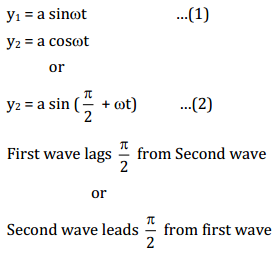
Two wave are represented by the equations $\mathrm { y } _ { 1 } = \mathrm { a } \sin \omega \mathrm { t }$ and $\mathrm { y } _ { 2 } = \mathrm { a } \cos \omega \mathrm { t }$. The first wave :
  1. A Leads the second by π
  2. B Lags the second by π
  3. C Leads the second by $\frac { \pi } { 2 }$
  4. D Lags the second by $\frac { \pi } { 2 }$
Show answer & explanation

Correct answer: D

Wave Optics – NEET-21600

Attempt this as a timed test

Reading answers is not the same as sitting the paper. Attempt it timed and you get your score, per-question timing, and the mistakes tracked for revision.

Start free

More Wave Optics tests

All Wave Optics tests →