Wave Optics — DPP 3

20 NEET questions from Wave Optics, with answers and explanations. Attempt it as a timed test to get scoring, accuracy breakdown and mistake tracking.

Attempt this test free 20 questions · 30 minutes · +80 marks
1
In white light interference, nearest to the central (bright) fringe, will have which of the following colour
  1. A violet
  2. B yellow
  3. C red
  4. D green
Show answer & explanation

Correct answer: C

Nearest to the central bright fringe red colour appear.
2
In YDSE experiment, when two light waves make third minima, then they have :-
  1. A Phase difference of 3π
  2. B Phase difference of $\frac { 5 \pi } { 2 }$
  3. C Path difference of 3λ
  4. D Path difference of $\frac { 5 \lambda } { 2 }$
Show answer & explanation

Correct answer: D

$\begin{array}{l}\Delta \mathrm{x}=(2 \mathrm{n}-1) \lambda / 2 \& \mathrm{n}=3 \\ \therefore \quad \Delta \mathrm{x}=\frac{5 \lambda}{2}\end{array}$
3
When exposed to sunlight, thin films of oil on water often exhibit brilliant colors due to the phenomenon of -
  1. A interference
  2. B diffraction
  3. C dispersion
  4. D polarisation
Show answer & explanation

Correct answer: A

Thin film of oil on water appear colourful due to the phenomenon interference.
4
In Young's double slit experiment, the two slits act as coherent sources of equal amplitude A and wavelength λ. In another experiment with the same set up the two slits are sources of equal amplitude A and wavelength λ but are incoherent. The ratio of the intensity of light at the mid-point of the screen in the first case to that in the second case is :
  1. A 4 : 1
  2. B 2 : 1
  3. C 1 : 1
  4. D None of the above
Show answer & explanation

Correct answer: B

$\frac{\mathrm{I}_{\text {coherent }}}{\mathrm{I}_{\text {noncoherent }}}=\frac{4 \mathrm{I}_{0}}{2 \mathrm{I}_{0}}=\frac{2}{1}$
5
In Young's double slit experiment, wavelength of light is $6000 \AA$. Then the phase difference between the light waves reaching the third bright fringe from the central fringe will be :
  1. A zero
  2. B 2π
  3. C 4π
  4. D 6π
Show answer & explanation

Correct answer: D

Third Bright
$\begin{array}{l}\Delta x=3 \lambda \\ \Delta \phi=6 \pi\end{array}$
6
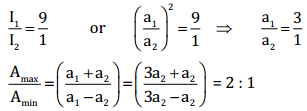
If intensity ratio of two interfering waves is 9 : 1 then ratio of maximum to minimum amplitude of resultant wave is :-
  1. A 2 : 1
  2. B 3 : 2
  3. C 1 : 3
  4. D 5 : 2
Show answer & explanation

Correct answer: A

Wave Optics – NEET-21607
7
The fringe width in Young's double slit experiment increases when:
  1. A Wavelength increases
  2. B Distance between the slits increases
  3. C Distance between the source and screen decreases
  4. D Frequency of incident light increases
Show answer & explanation

Correct answer: A

$\beta=\frac{\lambda \mathrm{D}}{\mathrm{d}} \therefore \beta \propto \lambda$
8
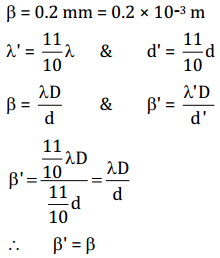
In Y.D.S.E. the fringe width is 0.2 mm. If wavelength of light is increase by 10% and separation between the slits is increased by 10% then fringe width will be :
  1. A 0.20 mm
  2. B 0.165 mm
  3. C 0.401 mm
  4. D 0.242 mm
Show answer & explanation

Correct answer: A

Wave Optics – NEET-21635
9
In Young's double slit experiment, if monochromatic light is replaced by white light:
  1. A All bright fringes become white
  2. B All bright fringes have coloures between violet and red
  3. C Only the central fringe is white, all other fringes are coloured
  4. D No fringes are observed
Show answer & explanation

Correct answer: C

Central fringe is white and all other fringes are coloured.
10
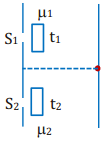
In a Young's double slit experiment, a slab of thickness 1.2 μm and refractive index 1.5 is placed in front of one slit and another slab of thickness t and refractive index 2.5 is placed in front of the second slit. If the position of the central fringe remains unaltered, then the thickness t is-
Wave Optics – NEET-21634
  1. A 0.4 μm
  2. B 0.8 μm
  3. C 1.2 μm
  4. D 7 μm
Show answer & explanation

Correct answer: A

∵ Central fringe at same position.
∴ Path difference $(\Delta \mathrm{x})=0$
Now $\left(\mu_{1}-1\right) \mathrm{t}_{1}=\left(\mu_{2}-1\right) \mathrm{t}_{2}$
$\begin{array}{l}(1.5-1) \times 1.2=(2.5-1) \mathrm{t}_{2} \\ \mathrm{t}_{2}=\frac{0.5 \times 1.2}{1.5}=0.4 \mu \mathrm{~m}\end{array}$
11
Two coherent light sources emit light of the
  1. A same intensity
  2. B different frequency
  3. C constant phase difference but different wavelengths
  4. D same frequency having constant phase difference
Show answer & explanation

Correct answer: D

Two coherent light sources emit light of the same frequency having constant phase difference.
12
When a thin transparent plate of thickness t and refractive index μ is placed in the path of one of the two interfering waves of light, then the path difference changes by :
  1. A $( \mu + 1 ) \mathrm { t }$
  2. B $( \mu - 1 ) \mathrm { t }$
  3. C $\frac { ( \mu + 1 ) } { t }$
  4. D $\frac { ( \mu - 1 ) } { t }$
Show answer & explanation

Correct answer: B

$\Delta \mathrm{x}_{\text {slab }}=(\mu-1) \mathrm{t}$
13
If a transparent medium of refractive index μ = 1.5 and thickness $\mathrm{t}=2.5 \times 10^{-5} \mathrm{~m}$ is inserted in front of the slits of Young's double-slit experiment, how much will be the shift in the interference pattern? The distance between the slits is 0.5 mm and that between slits and screen is 100 cm:
  1. A 5 cm
  2. B 2.5 cm
  3. C 0.25 cm
  4. D 0.1 cm
Show answer & explanation

Correct answer: B

$\begin{array}{l}x=\frac{(\mu-1) t D}{d} \\ \Rightarrow \quad x=\frac{(1.5-1) \times 2.5 \times 10^{-5} \times 1}{0.5 \times 10^{-3}} \\ \Rightarrow \quad 2.5 \mathrm{~cm}\end{array}$
14
In an interference experiment, the spacing between successive maxima or minima is:
  1. A $\frac { \lambda d } { D }$
  2. B $\frac { \lambda D } { d }$
  3. C $\frac { d D } { \lambda }$
  4. D $\frac { \lambda d } { 4 D }$
Show answer & explanation

Correct answer: B

Spacing between successive maxima or successive minima is fringe width (β) = $\frac{\lambda \mathrm{D}}{\mathrm{d}}$
15
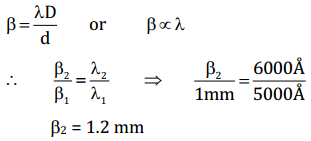
In a double slit experiment if light of wavelength $5000 \AA$ is used then fringe width of 1 mm is obtained. If now light of wavelength $6000 \AA$ is used without altering the system then new fringe width will be :
  1. A 1 mm
  2. B 0.5 mm
  3. C 1.2 mm
  4. D 1.5 mm
Show answer & explanation

Correct answer: C

Wave Optics – NEET-21646
16
In Young's experiment, monochromatic light through a single slit S is used to illuminate the two slits $S _ { 1 }$ and $S _ { 2 }$. Interference fringes are obtained on a screen. The fringe width is found to be w. Now a thin sheet of mica (thickness t and refractive index μ) is placed near and in front of one of the two slits. Now the fringe width is found to be $\mathrm { w } ^ { \prime }$, then :
  1. A $w ^ { \prime } = w / \mu$
  2. B $\mathrm { w } ^ { \prime } = \mathrm { w } \mu$
  3. C $\mathrm { w } ^ { \prime } = ( \mu - 1 ) \mathrm { tw }$
  4. D $w ^ { \prime } = w$
Show answer & explanation

Correct answer: D

In presence of thin mica sheet fringe width remain same but fringe pattern shift (w' = w)
17
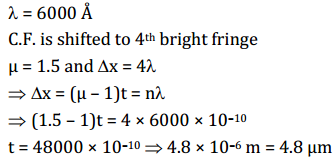
The central fringe of interference pattern produced by light of wavelength $6000 \AA$ is found to shift to the position of $4 ^ { \text {th } }$ bright fringe, after a glass plate of μ = 1.5 is introduced. The thickness of the glass plate is :
  1. A 4.8 μm
  2. B 8.23 μm
  3. C 14.98 μm
  4. D 3.78 μm
Show answer & explanation

Correct answer: A

Wave Optics – NEET-21633
18
Young's double slit experiment is performed with light of wavelength 550 nm. The separation between the slits is 1.10 mm and screen is placed at distance of 1 m. What is the distance between the consecutive bright or dark fringes.
  1. A 1.5 mm
  2. B 1.0 mm
  3. C 0.5 mm
  4. D None of these
Show answer & explanation

Correct answer: C

$\beta=\frac{\lambda D}{d}=\frac{550 \times 10^{-9} \times 1}{1.1 \times 10^{-3}}=500 \times 10^{-6} \Rightarrow 0.5 \mathrm{~mm}$
19
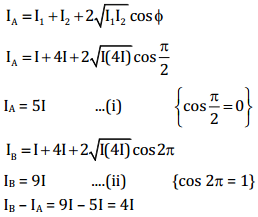
Two beams of light having intensities I and 4 I interfer to produce a fringe pattern on a screen. The phase difference between the beam is $\frac { \pi } { 2 }$ at point A and 2π at point B. Then find out the difference between the resultant intensities at A and B.
  1. A 2 I
  2. B 5 I
  3. C I
  4. D 4 I
Show answer & explanation

Correct answer: D

Wave Optics – NEET-21560
20
A very thin transparent film of soap solution (thickness → 0) is seen under reflection of white light. Then the colour of the film appear to be :
  1. A blue
  2. B black
  3. C red
  4. D yellow
Show answer & explanation

Correct answer: B

When thickness tends to zero
thin film appear dark in reflected system
$\Delta \mathrm{x}=2 \mu \mathrm{t} \cos \mathrm{r}-\frac{\lambda}{2}$

Attempt this as a timed test

Reading answers is not the same as sitting the paper. Attempt it timed and you get your score, per-question timing, and the mistakes tracked for revision.

Start free

More Wave Optics tests

All Wave Optics tests →